Definitive Technology Subwoofers for Home Theater
A movie soundtrack can look incredible on a large display and still feel flat if the room is missing low-frequency impact. The rumble of a launch, the weight of a concert kick drum, and the subtle tension beneath a quiet scene all depend on bass you can feel as well as hear. Definitive Technology subwoofers are designed to supply that foundation without turning a polished living room or dedicated theater into a cluttered equipment space.
For Florida homeowners building a media room, upgrading a family room, or improving an outdoor entertainment area, the right subwoofer is not about chasing the biggest box or the highest wattage number. It is about matching the equipment, room, placement, and system design so bass feels controlled, full, and natural at the seats where people actually watch and listen.
What Definitive Technology Subwoofers Bring to a System
A subwoofer handles the lowest frequencies that standard speakers struggle to reproduce with authority. When it is properly integrated, your front, center, and surround speakers are free to focus on dialogue, detail, and dynamics. The result is more than extra boom. Voices can become clearer, effects have more scale, and music gains the low-end body that makes a performance feel present.
Definitive Technology has a long history of designing speakers and powered subwoofers for immersive home entertainment. Depending on the model, the brand’s subwoofers may use high-excursion drivers, passive radiators, digital amplification, and app-based or onboard controls to produce meaningful output from cabinets that are easier to accommodate than oversized traditional designs.
That compact approach matters in real homes. A dedicated theater may have room for large enclosures and multiple subwoofers, but a living room with custom furniture, windows, and a clean design often needs a solution that performs without dominating the floor plan. A professionally selected model can provide cinematic low end while keeping equipment placement intentional and wiring out of sight.
Choosing the Right Definitive Technology Subwoofer
The best choice begins with the room, not the product label. An open-concept great room connected to a kitchen and hallway requires more air movement than a closed media room of the same seating area. High ceilings, tile floors, glass, and open doorways can also change what the system needs.
Room volume matters more than square footage
A 16-by-18-foot room with an eight-foot ceiling behaves very differently from that same footprint with a vaulted ceiling and open access to other spaces. The second room has far more volume to fill, so a compact entry-level subwoofer may sound acceptable at lower levels but run out of headroom during action movies or energetic music.
For a smaller bedroom, office, or enclosed den, a smaller powered subwoofer may be exactly right. For a large family room or home theater with several rows of seating, a larger cabinet, greater amplifier capability, or a dual-subwoofer layout is often the smarter investment. More capability does not mean the system must always play louder. It means it can play cleanly and comfortably when the soundtrack asks for it.
Think about how you use the room
Movie-first systems benefit from low-frequency extension and dynamic impact. Music-first systems often place equal emphasis on speed, control, and a smooth blend with the main speakers. A mixed-use room needs both.
Consider the volume levels you enjoy as well. If the goal is casual TV and background music, a modest model can make a major improvement. If you want reference-style movie playback on weekends, a subwoofer with more output reserve will better hold together when the soundtrack gets demanding.
A matched system is easier to tune
Definitive Technology speakers and subwoofers can work well together, but a subwoofer does not have to match the brand of your existing speakers to be effective. The key is proper calibration. Your AV receiver, crossover settings, speaker locations, and room acoustics determine whether bass integrates as one cohesive soundstage or calls attention to itself from a corner.
This is where professional design adds real value. Equipment specifications are useful, but they cannot tell you how a particular room will respond until placement and tuning are addressed.
Placement Is the Difference Between Bass and Boom
Subwoofers interact with room boundaries more than most people expect. Moving a subwoofer a few feet can increase output at one seat, weaken it at another, or create a boomy note that overwhelms dialogue. Placing it in a corner often provides more output, but it can also exaggerate certain frequencies. Sometimes that is the right choice. Sometimes it is the reason a system sounds muddy.
Start with practical placement near the front of the room, where wiring can be concealed and the cabinet fits the design. Then test and calibrate. If the primary listening position has uneven bass, relocating the subwoofer may help more than changing settings.
For larger rooms, two subwoofers can be a better solution than one very large unit. Dual subs do not merely add volume. When placed thoughtfully, they can smooth out bass response across multiple seats, which is especially useful for family movie nights and theater rooms with more than one row. This option depends on budget, available locations, and the ability to run wiring cleanly during installation.
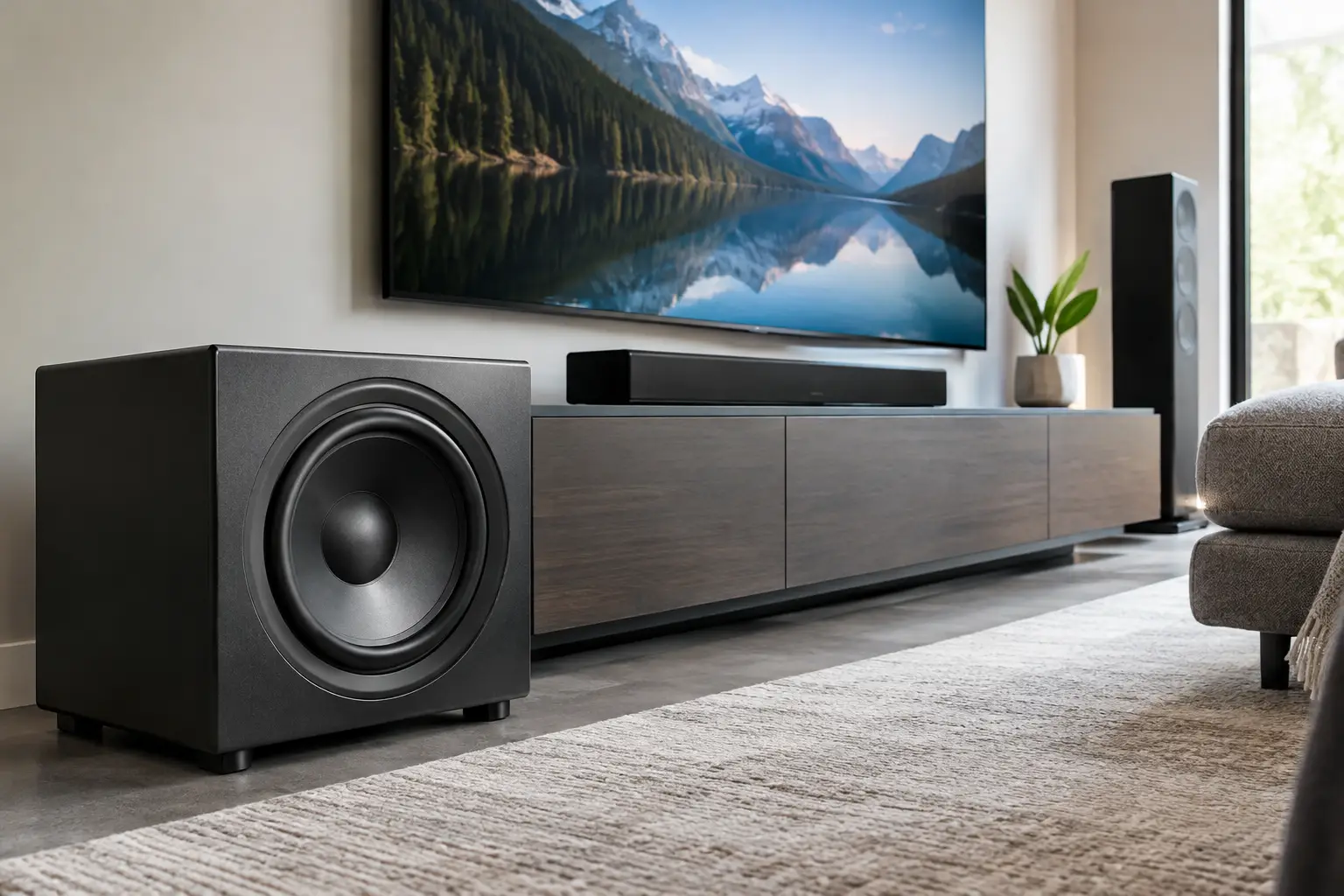
Avoid placing a subwoofer inside a tightly enclosed cabinet unless that cabinet was built with appropriate ventilation and acoustic clearance. Powered subwoofers create vibration, need airflow, and need room for the driver or passive radiators to operate as intended. A clean installation should protect both the room’s appearance and the equipment’s performance.
Setup Settings That Matter
A good subwoofer can still disappoint if the system is set up incorrectly. The receiver’s room correction program is a useful starting point, not always the final word. After calibration, an installer should verify levels, crossover points, phase, distance settings, and real-world listening results.
The crossover determines where your main speakers hand off bass to the subwoofer. Set too low, smaller speakers may strain. Set too high, bass may become easier to locate or the transition may lose naturalness. The ideal point depends on the speakers, the subwoofer, and the room. Many systems land around the commonly used 80 Hz range, but there is no universal setting that fits every installation.
Phase adjustment can also improve how the subwoofer blends with the front speakers. When phase is misaligned, bass at the crossover region can partially cancel, leaving the system sounding thin even though the subwoofer is powered on. This is one reason a quick plug-in setup rarely delivers the performance people expect from premium equipment.
Integration for a Clean Florida Home
Florida homes often present specific installation considerations: open floor plans, hard surfaces, outdoor-adjacent living spaces, and a preference for bright, uncluttered interiors. The subwoofer itself should feel like part of the room, not an afterthought with a visible cable stretched across the floor.
A custom AV installation can conceal signal and power planning where appropriate, position the subwoofer around furniture and traffic patterns, and incorporate control into one easy-to-use system. That means no confusing sequence of remotes when it is time to watch a game, start a movie, or play music by the pool.
Frequencies USA designs entertainment systems around the way each client uses the space. Sometimes that calls for a single compact subwoofer that disappears into a family room. Other times, it means a dedicated theater with multiple low-frequency channels, acoustic planning, hidden wiring, and calibrated performance at every seat.
When a Subwoofer Upgrade Makes Sense
If voices are clear but movies lack impact, if music sounds thin at moderate volume, or if you keep increasing the bass control without getting satisfying results, a subwoofer upgrade may be the answer. It can also be worthwhile when moving from a soundbar to a true surround system, adding a larger display, or converting a spare room into a media room.
The right upgrade should make the entire system feel more complete, not simply louder. A well-chosen Definitive Technology subwoofer adds scale when a scene demands it, then stays controlled enough to let the rest of the soundtrack breathe. That balance is what makes a room more enjoyable for everyday listening and memorable when the lights go down.
 Previous Post
 Next Post