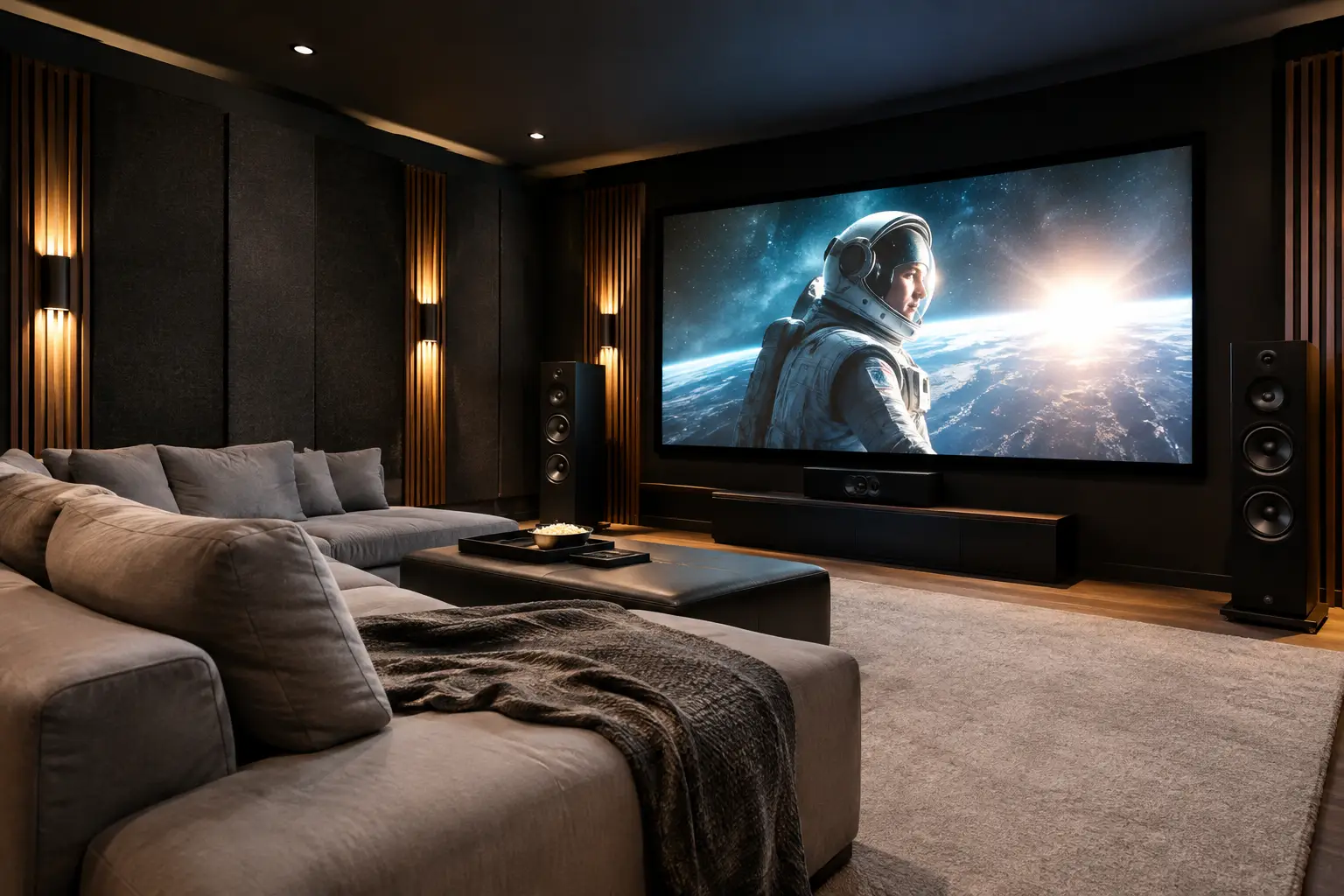
Home Theater Acoustics That Make Movies Feel Real
A beautiful 4K image can pull you into a movie, but poor sound can pull you right back out. When dialogue gets buried under music, bass rattles the room instead of hitting with impact, or one chair sounds noticeably better than another, the issue is often not the receiver or speakers. It is home theater acoustics.
Acoustics determine how sound behaves after it leaves your speakers. In a professionally designed theater or media room, the goal is not simply to make everything louder. It is to create clear, balanced, immersive sound that feels natural at every seat, while keeping the room polished and comfortable for everyday living.
Why Home Theater Acoustics Matter
Speakers send sound into the room, where it immediately interacts with walls, ceilings, floors, windows, furniture, and open doorways. Hard surfaces reflect sound. Corners collect low-frequency energy. Large empty spaces can produce echoes that soften dialogue and blur effects.
That is why a premium speaker package can still disappoint in the wrong room. A less expensive system in a thoughtfully designed space can often sound more detailed, more dynamic, and more enjoyable. The equipment matters, but the room gets the final word.
Good acoustics improve the parts of a soundtrack people notice most. Dialogue becomes easier to understand without turning up the volume. Surround effects move more convincingly around the room. Bass has weight and control instead of a constant boom. You also get a more consistent experience, so the family on the couch and guests in the back row are not hearing two completely different movies.
For Florida homeowners, this planning can be especially valuable in open-concept homes with tile or hardwood flooring, high ceilings, expansive glass, and modern clean-lined finishes. Those features look great, but they can create plenty of reflective surfaces. The answer is not covering every wall with visible foam. It is selecting the right acoustic strategy for the room and the look you want.
Start With the Room Before Choosing Treatments
Every room has limitations, and a good theater design works with them. Room dimensions, ceiling height, seating location, screen wall placement, and the amount of available wall space all influence acoustic performance.
A dedicated enclosed theater provides the most control. You can plan speaker locations, seating distances, bass management, lighting, and acoustic treatments as one complete system. A living room or multipurpose media room requires more compromise, but it can still deliver exceptional results with careful speaker placement and discreet treatment options.
Avoid the center of the room
The exact center of a room is often a difficult spot for seating because bass frequencies can cancel or build up there. You may hear too little bass at one seat and far too much only a few feet away. Moving the primary seating position forward or backward can make a major difference before any product is installed.
Speaker locations deserve the same attention. Front speakers should create a clear soundstage across the screen, while surround and height channels should be positioned around the listening area, not simply placed wherever wiring is easiest. Concealed wiring keeps the finish clean, but performance still drives the layout.
Treat the room you have
There is no universal formula for how many acoustic panels a room needs. A carpeted media room with upholstered furniture behaves very differently from a theater with tile floors, leather recliners, and a wall of glass. Too little absorption leaves the room overly reflective. Too much can make it sound unnaturally dry and lifeless.
The right approach balances absorption, diffusion, and bass control. Each serves a different job, and each can be incorporated without sacrificing the visual polish of the space.
The Three Acoustic Problems Worth Solving
Reflections that blur dialogue
When sound bounces off a side wall, ceiling, or floor and reaches your ears just after the direct sound from a speaker, clarity suffers. These early reflections can make voices feel smeared or force you to raise the volume to catch every line.
Acoustic panels at key reflection points help absorb those unwanted echoes. In a theater, fabric-wrapped panels can be color-matched to the room. In a living space, they may be disguised as custom artwork or integrated into wall details. Thick area rugs, drapery, and upholstered furniture can also help, although they should support a full plan rather than replace one.
Bass that overwhelms the room
Low frequencies are the hardest part of home theater acoustics to manage. Bass waves are long, powerful, and affected heavily by room dimensions. The common result is a room with booming bass in the corners, weak bass in a center seat, and a soundtrack that feels more muddy than cinematic.
Subwoofer placement is the first lever. One subwoofer in a convenient corner may create a lot of output, but it may not create even output. In many rooms, two properly positioned subwoofers provide smoother bass across multiple seats than one larger subwoofer. Calibration then fine-tunes timing, levels, crossover points, and equalization.
Bass traps or purpose-built low-frequency treatments may be appropriate in dedicated theaters, especially where room dimensions create strong resonances. They require more depth than a typical wall panel, so planning them early protects both the room layout and the finished appearance.
A room that sounds flat or closed-in
Absorption reduces unwanted reflections, but a theater also needs a sense of spaciousness. Diffusion scatters sound in multiple directions rather than absorbing it completely. This can help a room feel larger and more enveloping without adding harsh echo.
Diffusers are often placed on rear walls or other surfaces behind the seating area. They are particularly useful in dedicated theaters where viewers sit close to a back wall. Like acoustic panels, they can be built into custom architectural details rather than treated as an afterthought.
Build Acoustics Into the Design, Not Onto It
The best-performing theater is usually the one where acoustics were considered before construction or renovation. That is the moment to plan in-wall speakers, a projector location, hidden equipment, power, ventilation, lighting, and treatment locations together.
This integrated approach avoids common compromises. For example, a ceiling full of recessed lights may conflict with ideal Atmos speaker placement. A large decorative mirror may create strong reflections on a side wall. A bulky cabinet can block speaker output or leave no practical place for a subwoofer. These choices are easier and more affordable to address on paper than after the drywall and finishes are complete.
A polished room does not have to advertise its technology. Speakers can disappear into walls and ceilings. Equipment can be located in a ventilated cabinet or dedicated rack. Acoustic treatments can complement the color palette, wall texture, and lighting design. The result is a room that looks intentional even when the system is off.
At Frequencies USA, that is the value of a custom design process: the performance details are handled behind the scenes, while the homeowner gets an easy-to-use space with clean lines and no visible wire clutter.
Calibration Is the Final Performance Step
Even a well-designed room needs professional calibration. Receivers and processors often include automated setup tools, and they can be useful starting points. However, automated calibration cannot move a poorly placed speaker, correct an unsuitable seating position, or fully account for every design choice in a complex room.
A complete calibration checks speaker distances, levels, crossover settings, phase, subwoofer integration, and surround balance. It also confirms that dialogue is anchored to the screen and that immersive effects are positioned correctly. Small adjustments can have an outsized effect, especially when combining multiple subwoofers or height speakers.
This is also where convenience becomes part of the experience. A properly configured control system lets you select a movie, adjust volume, manage lighting, and set the room for entertaining without juggling remotes or explaining a complicated setup to guests.
When Acoustic Treatment Is Worth the Investment
Not every room needs a fully treated cinema. If you primarily watch casually in a furnished family room, strategic speaker placement, a quality rug, soft furnishings, and accurate calibration may deliver the improvement you want. If you are building a dedicated theater, love concert films and action movies, or regularly host family and friends, purpose-designed treatment is usually one of the smartest places to invest.
The key is spending where it makes an audible difference. Decorative foam squares, random panels, and oversized subwoofers are not substitutes for a room-specific plan. A professional assessment can identify the real issues first, then recommend solutions that fit the room, the budget, and the desired finish.
A great theater should make you forget about the equipment and the room itself. When the dialogue is clear, the bass feels controlled, and every seat is part of the action, the technology has done exactly what it should: it has made time at home more memorable.
 Previous Post