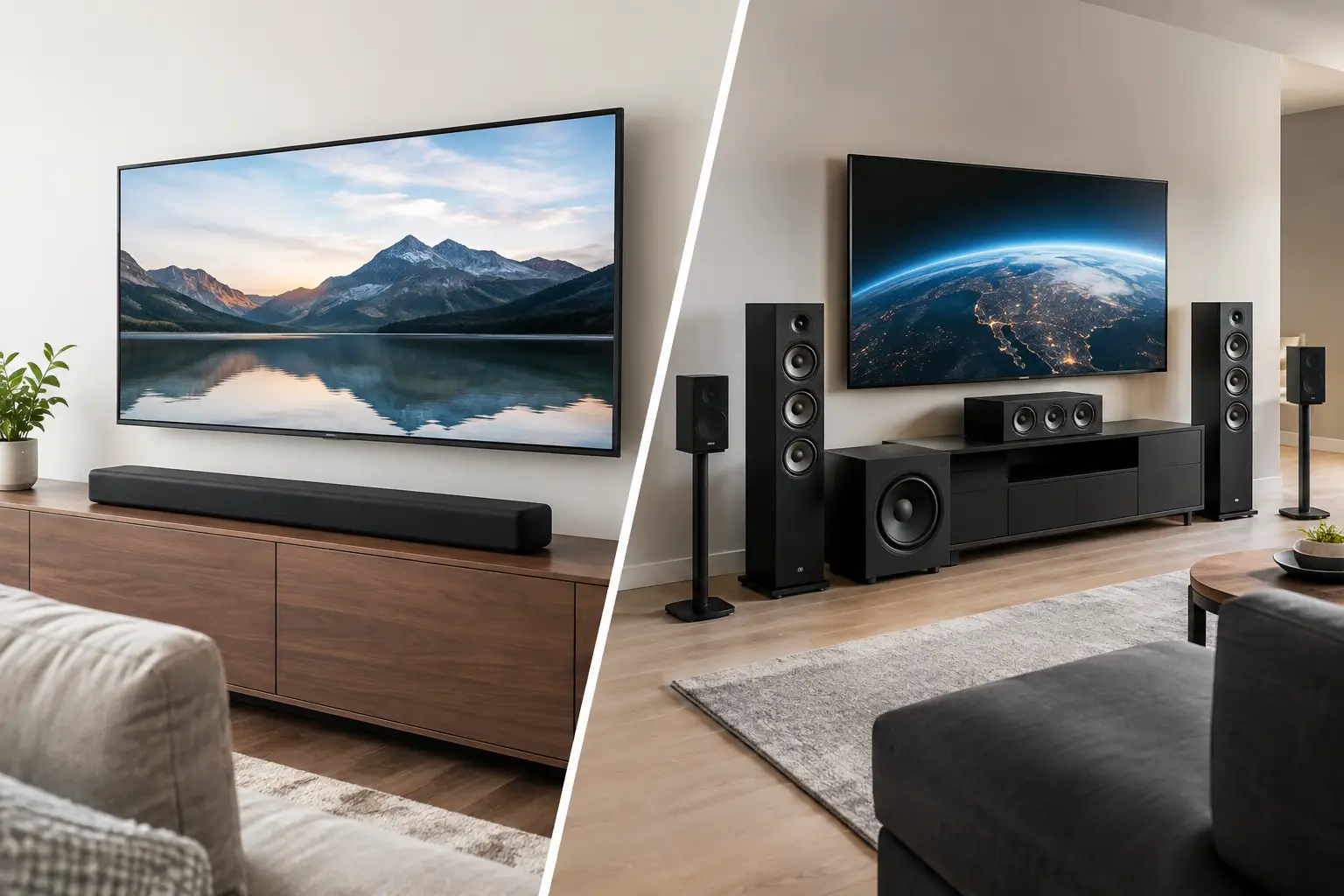
Soundbar Versus Surround Sound: Which Fits?
A new TV can make a living room look better in one afternoon. Better sound is what makes it feel like a true entertainment space. In the soundbar versus surround sound decision, the right answer is less about chasing the biggest system and more about how you use the room, what you watch, and how clean you want the finished space to look.
For some Florida homes, a premium soundbar is the smart, polished upgrade that makes TV dialogue clear and movie nights more exciting without changing the room’s layout. For others, a properly designed surround sound system creates the kind of immersive experience that turns a media room, man cave, or dedicated theater into everyone’s favorite place to sit.
Soundbar Versus Surround Sound: The Core Difference
A soundbar places multiple speakers in one low-profile cabinet beneath or above the TV. Most models connect easily to modern televisions, and many can simulate left, center, right, and even overhead effects using digital processing. Add a wireless subwoofer and the system gains the low-frequency impact that makes action scenes, concerts, and sports feel more complete.
A surround sound system uses separate speakers positioned around the listening area. At minimum, that often means front left, center, and right speakers, plus a subwoofer and two surround speakers. More advanced layouts add rear speakers and in-ceiling or height speakers for Dolby Atmos effects. Because sound comes from distinct locations, a surround system can place voices, music, and effects around the room with greater accuracy.
That difference matters when the scene calls for it. A soundbar can create a wide, satisfying soundstage from the front of the room. A surround system can make the helicopter move from behind the sofa to the screen, put rain above the seating, and keep dialogue anchored precisely to the actor speaking.
When a Soundbar Is the Better Choice
A soundbar is not automatically the “basic” option. Premium soundbars have improved dramatically, and they are a strong fit for rooms where convenience, aesthetics, and everyday television viewing matter most.
You want a clean upgrade with minimal visual impact
For a family room with an open layout, large windows, or carefully designed furniture, a soundbar keeps the installation discreet. It can be mounted neatly with a wall-mounted TV or placed on a console, while a hidden connection path prevents dangling cords from taking attention away from the display.
This approach works especially well when the TV is the room’s primary entertainment feature, but not the room’s entire purpose. You get fuller sound, stronger dialogue, and meaningful bass without introducing speakers at every corner.
Your viewing is mostly TV, sports, and casual streaming
News, sitcoms, sports, and most streaming shows benefit immediately from a quality soundbar. The center-channel processing on many models helps make voices easier to hear, which is a major improvement over thin TV speakers. A subwoofer adds depth to game-day crowds, music, and movie soundtracks without requiring a full theater layout.
Soundbars also make practical sense in bedrooms, guest rooms, condos, and secondary TVs. They offer a noticeable result without overbuilding the space.
You prefer simple everyday control
The best home technology is easy to enjoy. A well-integrated soundbar can work with your TV remote or a simple universal control, so family members and guests are not sorting through remotes just to watch a show. With the right equipment selection and setup, turning on the TV can turn on the sound system automatically.
The trade-off is physical realism. Even excellent soundbars work within the limits of having most speakers located at the front of the room. Virtual surround effects can be impressive, but they cannot fully replace speakers positioned behind or beside the listener.
When Surround Sound Is Worth It
Surround sound is the better investment when entertainment is a priority and the room gives the system a fair chance to perform. It does not have to mean a crowded room full of large black boxes. Professional design makes a major difference in how refined the finished system looks and feels.
You want movie-theater immersion at home
If movies, gaming, concerts, and big sporting events are a regular part of your household, separate speakers deliver a more convincing experience. The center speaker handles dialogue clearly, front speakers create a broad screen-side soundstage, and surround channels carry effects beyond the TV wall.
In a dedicated media room, the difference is immediate. A suspense scene becomes more involving because subtle effects appear around the seating position. An action movie has impact without forcing every sound through one speaker enclosure. Video games become more directional, which adds excitement and can even help players react faster.
You have a room that can support speaker placement
Surround sound performs best when seating has some space around it. A sectional pressed tightly against the back wall can limit where rear speakers should go, but it does not always rule out surround sound. In-wall speakers, in-ceiling speakers, carefully placed side surrounds, or a customized layout can solve problems that a one-size-fits-all package cannot.
Room acoustics matter too. Tall ceilings, tile floors, glass doors, open kitchens, and hard surfaces are common in Florida homes, and they can all affect clarity and bass. The goal is not simply to add more speakers. It is to choose speaker locations, subwoofer placement, and calibration settings that suit the room.
You care about long-term flexibility
A component-based surround system is easier to expand or refine over time. You may start with a 5.1 layout, then add height speakers later for Dolby Atmos. You can upgrade the receiver, subwoofer, or front speakers without replacing every part of the system.
That flexibility comes with more planning. Surround sound needs speaker wire, power, equipment space, and thoughtful setup. A professional installation can conceal wiring in walls and ceilings, place equipment cleanly, and avoid the visual clutter that causes many homeowners to hesitate.
The Design Question Matters as Much as the Sound
Many homeowners compare systems by speaker count, then overlook the way the installation will look every day. That is where customized AV design earns its value.
A soundbar can sit nearly invisible below a display. Surround sound can also preserve a clean aesthetic with paintable in-wall speakers, flush in-ceiling speakers, hidden subwoofer placement, and equipment stored in a cabinet or dedicated rack. The best option depends on whether you want technology to disappear or become a feature of the room.
For example, a bright, open living room may call for a high-performance soundbar with a concealed subwoofer connection. A windowless bonus room with theater seating may be ideal for a full surround layout with in-ceiling height channels. A covered pool area needs a different conversation altogether, since outdoor speakers are designed for broad coverage and durability rather than a traditional surround field.
Don’t Let the Room Dictate a Poor Compromise
It is tempting to buy a soundbar because it appears easier, or to buy a surround package because it has more channels on the box. Neither choice is automatically right.
A poorly placed surround system can sound uneven, look cluttered, and frustrate the people using it. On the other hand, a soundbar in a large room with a distant seating area may not provide the scale or immersion you expected. The size of the TV, seating distance, ceiling height, room boundaries, furnishing materials, and primary content all affect the recommendation.
Budget should be considered as a complete installed system, not just an equipment price. A soundbar usually has a lower starting cost and faster installation. A surround system costs more because it includes additional speakers, an AV receiver or processor, wiring, mounting, and calibration. But when a room is used frequently for movies or gaming, that higher investment can create years of better experiences.
A Practical Way to Choose
Start with the room’s purpose. If it is a shared living space used mostly for everyday TV and occasional movies, choose a quality soundbar if visual simplicity and easy operation are priorities. If the room is where your family gathers for movie nights, playoff games, and gaming sessions, evaluate a surround design before settling for a front-only solution.
Then think about what you want to hear. If clearer dialogue and more bass are the goal, a soundbar with a subwoofer may be exactly enough. If you want effects that travel around the room and soundtrack detail that feels layered rather than compressed, surround sound is the stronger choice.
Finally, consider how the installation should look after the work is done. Frequencies USA designs systems around the room, the equipment, and the people using it, with concealed wiring and controls that stay simple. The goal is not to fill a room with gear. It is to make every movie, game, and playlist feel better without compromising the home’s design.
The right system is the one you will enjoy without thinking about it: clear voices during a weeknight show, room-filling energy on game day, and sound that makes a favorite movie worth watching again.
 Previous Post
 Next Post