AV Receiver Features That Make Home Theater Easy
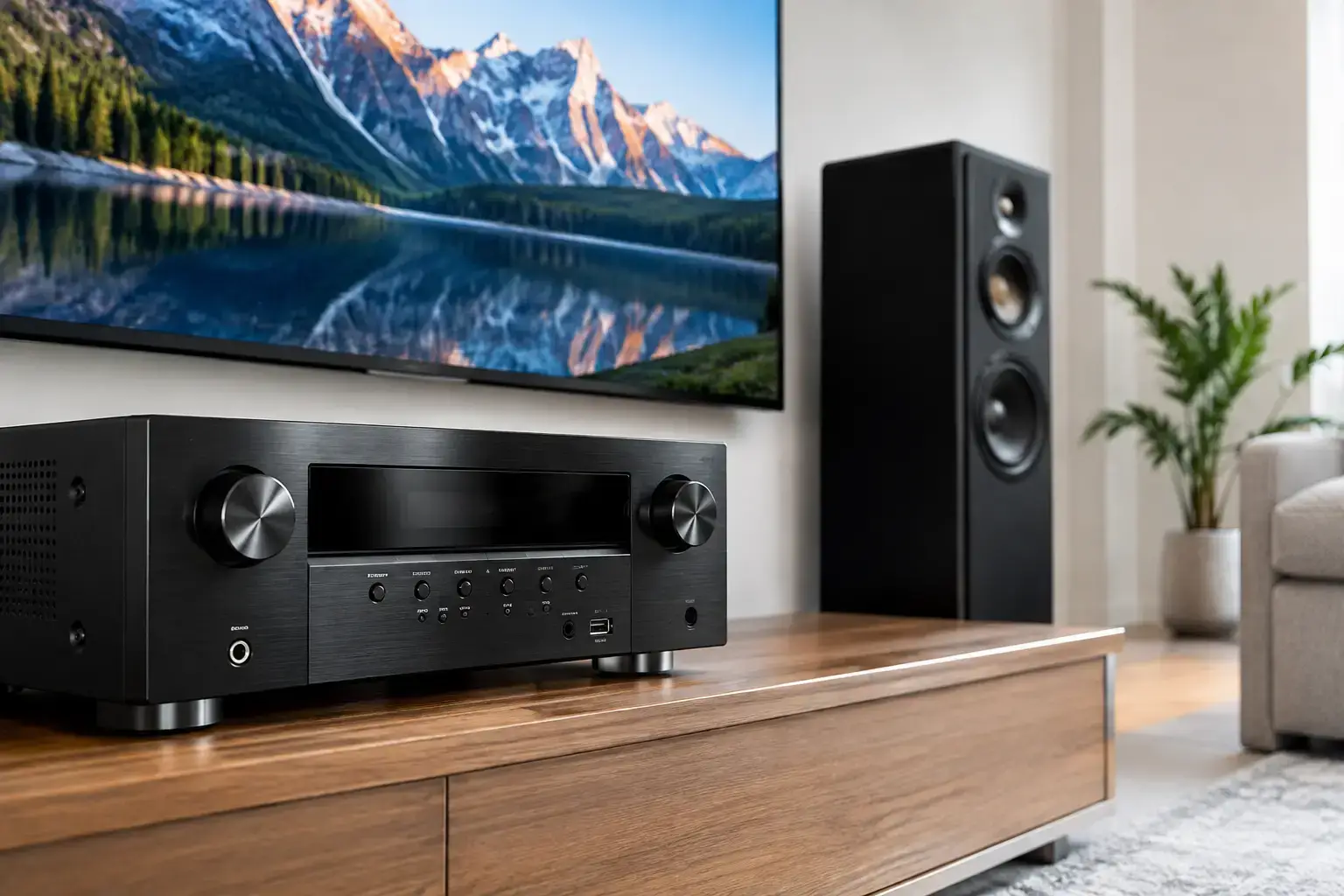
A great media room can look beautifully finished and still disappoint the moment the sound starts. Dialogue gets lost, bass feels thin, or switching from the game console to a movie becomes a hunt for remotes. The right AV receiver features solve those everyday frustrations behind the scenes. More than a box that powers speakers, the receiver is the control center that determines how easy your theater is to use, how convincing it sounds, and how well it can grow with your home.
For Florida homeowners planning a living-room upgrade, dedicated theater, game room, or covered outdoor entertainment area, the best receiver is not automatically the one with the longest specifications list. It is the one that matches the room, the speakers, the display, and the way your family actually watches and listens.
AV Receiver Features Worth Prioritizing
Enough channels for the sound you want
A receiver’s channel count tells you how many speakers it can power independently. A 5.1-channel setup uses front left, center, front right, two surround speakers, and a subwoofer. For many family rooms, that is a major improvement over TV speakers and a smart place to start.
A 7.1 system adds rear surround channels, while 5.1.2 or 7.1.2 systems add two height channels for Dolby Atmos. Those height speakers are what allow rain to seem overhead, aircraft to move across the room, and music soundtracks to feel more spacious. Larger dedicated theaters may benefit from four height channels, but more channels only help when the room layout supports proper speaker placement.
Power matters alongside channel count. Speakers with lower sensitivity, larger rooms, and higher listening levels ask more from an amplifier. A receiver that is underpowered may work at casual volume but sound strained during action scenes. The goal is comfortable headroom, not simply the biggest wattage number on the carton. Matching the receiver to the selected speakers is where professional design pays off.
HDMI connectivity that fits your equipment
Modern receivers manage the video path as well as sound. The number and type of HDMI inputs should accommodate current sources, such as a cable box, streaming device, Blu-ray player, and gaming console, with a little room for future additions. This is especially useful when your TV has limited HDMI ports or its connections are difficult to reach once wall-mounted.
For a new 4K television or projector, look for support for 4K video passthrough and HDR formats. Gamers should also consider HDMI 2.1 capabilities, including 4K at 120Hz, variable refresh rate, and auto low-latency mode. These features can reduce lag and preserve fast, smooth motion with compatible consoles and displays.
Not every household needs every video standard. If movie nights and streaming are the priority, reliable 4K HDR switching may be far more valuable than advanced gaming support. On the other hand, buying a receiver with too few HDMI inputs often creates an avoidable limitation just when the system becomes part of daily life.
Dolby Atmos, DTS:X, and sound processing
Surround formats are responsible for placing sound around and above the listener rather than keeping it locked to the front of the room. Dolby Atmos and DTS:X are the most familiar names, and both can create a more dimensional experience when paired with correctly placed speakers.
The center channel remains the workhorse for clear dialogue. A properly configured receiver can balance that speaker with the rest of the system, so voices remain understandable without turning up the whole room. This matters in open-concept homes, where hard surfaces, high ceilings, and household activity can make dialogue harder to follow.
A quality receiver should also provide useful adjustment options: individual speaker levels, crossover settings, dialogue enhancement, and different listening modes for movies, sports, and music. These controls should support the room, not turn the system into a permanent weekend project.
Room calibration that works with your space
No two rooms sound alike. Tile floors, glass doors, vaulted ceilings, rugs, furnishings, and open walls all affect how sound reaches the seating area. Automatic room calibration uses a supplied microphone to measure the speakers and make adjustments for distance, level, timing, and often equalization.
This is one of the most practical AV receiver features because it addresses the room you have, not a showroom demonstration. Calibration cannot fix poor speaker placement or replace acoustic treatment in a serious theater, but it can make a substantial difference in balance and clarity.
The trade-off is that automatic results are a starting point, not always the final word. A skilled installer may fine-tune crossover points, subwoofer output, and target curves after calibration. That extra attention is often what makes a system sound polished rather than merely loud.
Music streaming and multi-zone audio
A receiver can do more than movie duty. Many models support music streaming through popular services, Bluetooth, AirPlay, or network audio platforms. That makes it easy to play a playlist through the theater speakers without pulling out a separate component.
Multi-zone capability is worth considering when you want independent music in another area, such as a patio, pool space, dining room, or office. Some receivers can send a separate source to a second zone, while others may need an external amplifier for that purpose. The difference matters when planning outdoor audio or whole-home entertainment.
A receiver is not always the ideal foundation for a large multi-zone system. Homes with several listening areas often benefit from dedicated distributed-audio equipment and purpose-built controls. Still, a receiver with a second zone can be a practical solution for a simpler two-area setup.
Plan the Receiver Around the Room
The receiver should be chosen after the room plan begins to take shape, not before. Start with where people will sit, where the TV or projector will go, and whether the space is enclosed or open to other rooms. From there, speaker locations, subwoofer placement, equipment storage, and wiring routes become much easier to define.
A compact living room may call for an understated 5.1 system with in-wall or low-profile speakers. A dedicated theater may justify Atmos height channels, multiple subwoofers, and equipment installed in a ventilated cabinet or rack. For an outdoor TV area, the priority may shift toward weather-appropriate speakers, simple controls, and reliable network coverage.
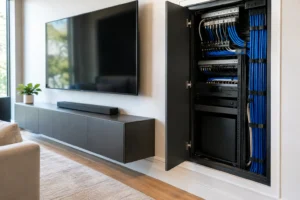
Receiver placement deserves attention too. These components generate heat, so they need airflow. Stuffing one into a tight decorative cabinet without ventilation can shorten its life and cause shutdowns at the worst possible moment. Concealed wiring, labeled connections, and accessible service space preserve the clean appearance homeowners want while keeping the system practical to maintain.
Control Is a Feature, Not an Afterthought
A powerful receiver becomes less valuable if guests or family members cannot use it confidently. One-touch control can turn on the display, select the right input, set the preferred audio mode, and dim the lights without requiring a lesson in HDMI settings.
Some households are comfortable using a receiver’s app and a few remotes. Others want a single handheld remote, wall keypad, or smart-home interface that keeps the experience simple. The right approach depends on the number of sources, zones, and users. What matters is making common tasks feel immediate while keeping deeper controls available when needed.
This is also where professionally installed systems stand apart. Frequencies USA can design the receiver, speakers, display, network connection, wiring, and controls as one coordinated system, so the finished room looks intentional and performs the way it should from day one.
When It Makes Sense to Spend More
Higher-tier receivers generally bring more channels, stronger amplification, better room correction, additional HDMI support, and expanded multi-zone options. They can be a smart investment for a larger theater, demanding speakers, frequent gaming, or a system expected to expand over several years.
But spending more is not automatically better. If the room only supports five speakers and a subwoofer, paying for eleven amplified channels may not improve the experience. Likewise, a premium receiver cannot compensate for a weak center speaker, a poorly placed subwoofer, or visible cables that undermine an otherwise beautiful room.
The strongest results come from putting the budget where it will be noticed: appropriate speaker selection, thoughtful placement, clean installation, and a receiver with the features your household will genuinely use. When the system is planned around real routines instead of a specifications checklist, movie night becomes the easy part of coming home.
 Previous Post