Camera System Comparison for Florida Properties
A security camera that misses a face at the driveway, drops offline during a storm, or sends an alert every time a palm frond moves is not providing much security. A useful camera system comparison starts with the real job the system must do: identify people and vehicles, cover vulnerable areas, preserve usable footage, and stay simple enough to check when it matters.
For Florida homeowners and business owners, the right choice also has to stand up to heat, heavy rain, humidity, changing light, and occasional power or internet interruptions. The best system is rarely the one with the longest feature list. It is the one designed around your property, priorities, and daily routine.
Camera System Comparison: Start With How You Will Use It
Before choosing camera brands or resolution levels, decide what you need to see and why. A front-door camera may need clear two-way audio and package alerts. A driveway camera should capture vehicle movement and faces without being blinded by headlights. A business may need broad coverage of entrances, registers, inventory areas, and parking spaces, with dependable recording for incident review.
Coverage also changes the answer. One or two cameras can be effective for a small entry area, but a larger home, pool deck, detached garage, or commercial property benefits from a coordinated system. Cameras should overlap at key approaches rather than leave gaps between isolated views.
A professionally planned layout considers camera height, sun direction, nighttime lighting, rooflines, landscaping, and the route for concealed wiring. That work often matters more than moving from one advertised resolution number to the next.
Wired vs. Wireless Security Cameras
The most common choice is between wired cameras and wireless cameras. Both can work well, but they solve different problems.
Wired cameras: dependable coverage for permanent protection
Wired systems typically use Ethernet cable, often with Power over Ethernet (PoE). One cable supplies both power and data, creating a clean, stable connection to a network video recorder or compatible recording system. For homes and businesses that need multiple cameras, long recording retention, or coverage in challenging outdoor locations, this is usually the stronger long-term option.
The biggest advantages are reliability and consistency. Wired cameras do not depend on batteries, and they are less vulnerable to Wi-Fi congestion or a weak signal at the edge of the property. They also support higher-quality video streams without competing with phones, TVs, gaming systems, and smart devices for wireless bandwidth.
The trade-off is installation. Running cable correctly takes planning and skill, especially when the goal is a polished property with no exposed wires. It is easier during construction or renovation, but an experienced installer can often route wiring discreetly through attics, soffits, walls, and equipment areas in an existing home.
Wireless cameras: flexible placement with practical limits
Wireless cameras send video over Wi-Fi. Some are battery-powered, while others still require an outlet for power. They can be useful for a small property, a temporary location, a difficult-to-wire area, or an addition to an existing system.
Their convenience comes with limitations. Battery cameras require charging or battery replacement. Wi-Fi cameras depend on signal strength, and exterior walls, metal framing, dense landscaping, and distance can weaken performance. A camera may look fine during setup but struggle when the network is busy or a storm affects outdoor conditions.
Wireless can be the right choice when wiring is genuinely impractical, but it should not be selected simply because it sounds easier. If a camera protects an important entrance, gate, register area, or vehicle access point, a wired connection is often worth the investment.
Cloud Storage vs. Local Recording
Where footage is stored affects cost, privacy, and what happens during an internet outage.
Cloud storage keeps clips or continuous recordings online. It is convenient because footage can be reviewed from almost anywhere, and the camera may continue uploading recordings even if the on-site equipment is damaged. Many cloud systems are easy for homeowners to manage, but subscriptions can add up as cameras and retention periods increase.
Local recording stores footage on a recorder, hard drive, or onboard memory card at the property. A network video recorder is particularly well suited to a multi-camera wired system. It can support continuous recording, longer retention, and high-quality video without recurring cloud fees for every camera.
The practical answer is often a hybrid approach. Record primary footage locally for speed and retention, then use remote app access and cloud features selectively for notifications or important event clips. This gives homeowners and business owners more control without giving up convenience.
Resolution Matters, But Only With the Right Design
Higher resolution can provide more detail, but more pixels alone do not guarantee better evidence. A 4K camera installed too high or aimed too broadly may still fail to identify a person at the distance that matters. Conversely, a well-positioned 4MP or 8MP camera can deliver excellent results in a targeted area.
For most properties, choose resolution based on the scene. A wide camera view is useful for situational awareness around a backyard or parking area. A narrower, purpose-placed view is better for capturing a face at a gate or a license plate at a driveway entrance. These are different jobs, and they may require different camera types.
Night performance deserves equal attention. Look for cameras with strong low-light capability, infrared illumination, and wide dynamic range. Wide dynamic range helps when a camera faces a bright sunset, glass entry door, headlights, or a shaded porch. In Florida, where intense sunlight can change quickly into a dark afternoon storm, that adaptability is valuable.
Choosing the Right Camera Type for Each Area
A camera system works best when each device is selected for its location instead of using the same model everywhere.
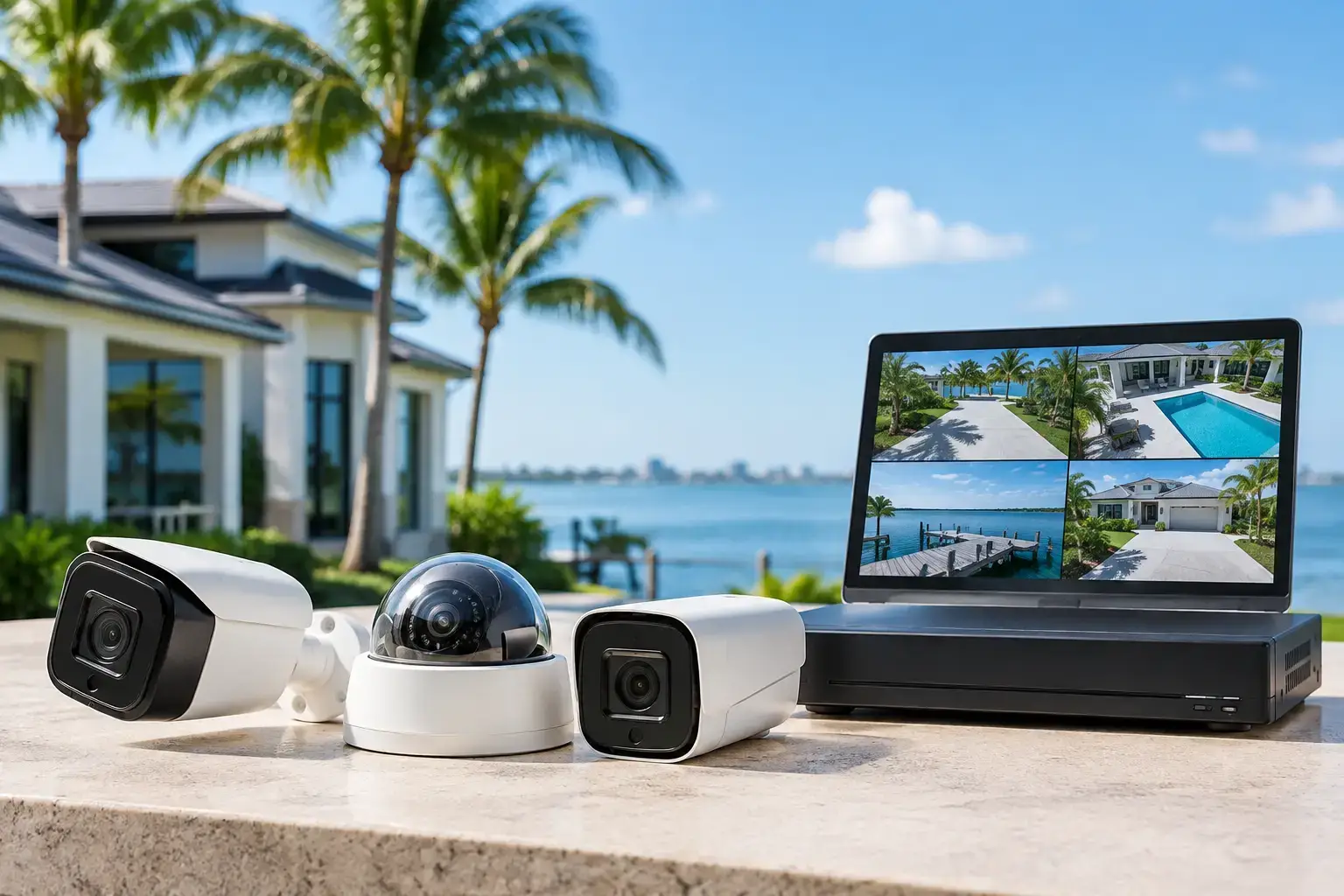
Bullet cameras are easy to aim and visibly communicate that an area is monitored. They are often effective for driveways, side yards, exterior doors, and perimeter views. Dome cameras are more compact and can be harder to redirect by hand, making them popular for covered entries, interiors, and commercial spaces. Turret cameras combine a clean profile with flexible aiming and typically avoid the glare issues that can affect some dome styles at night.
Doorbell cameras are useful for front-door interaction, deliveries, and visitor alerts, but they should not be expected to replace a complete exterior system. Their view is limited by the door location and angle. A dedicated camera covering the walkway or driveway often fills the gap.
For larger properties, pan-tilt-zoom cameras can monitor broad areas and allow active tracking or manual viewing. They are valuable in the right setting, but fixed cameras remain essential because they continuously watch their assigned view. A moving camera cannot look in two directions at once.
Features That Are Worth Paying For
Smart alerts can make a camera system more helpful or more annoying. Basic motion detection may trigger from rain, shadows, wildlife, and trees. Person, vehicle, package, and line-crossing detection can reduce unnecessary notifications when configured properly.
Two-way audio is helpful at entry points and business doors, while built-in sirens or lights may discourage unwanted activity. Privacy masking can block sensitive areas from recording, which is especially useful near neighboring properties or in a business setting. Remote access should be secure, easy to use, and available to the right household members or managers without sharing a single password.
Do not overlook backup power. A small uninterruptible power supply can keep network equipment, a recorder, and cameras operating through short outages. If your internet service goes down, locally recorded wired cameras can still capture footage even though remote viewing may be temporarily unavailable.
Why Professional Installation Changes the Result
A box of cameras does not automatically become a security system. Proper installation determines whether views are useful, cables are protected, recording settings are correct, and the finished property still looks refined.
Frequencies USA designs camera systems around the places people actually live and work – front entrances, pool areas, garages, side gates, offices, retail spaces, and parking areas. The goal is clear coverage, dependable performance, and clean installation that does not clutter the exterior with visible wiring or unnecessary equipment.
A professional also helps avoid expensive overbuying. Not every property needs the most advanced camera in every location. The better approach is to spend where detail and reliability matter most, then build a system that can expand as your needs change.
The right camera system should fade into the background until you need it. When an alert arrives, a delivery is made, or an incident needs review, you should have a clear view, dependable footage, and confidence that the system is doing its job.
 Previous Post
 Next Post