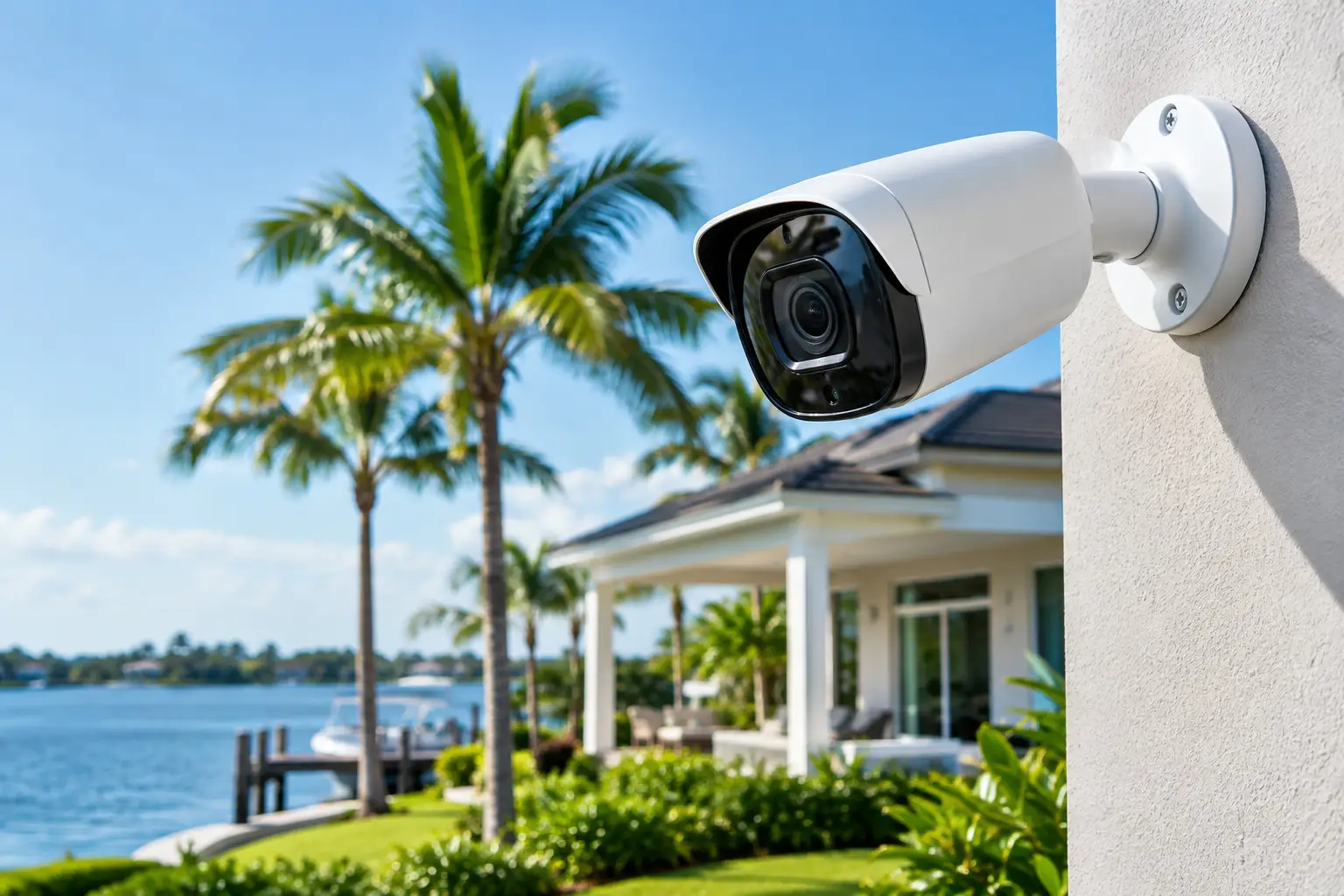
Security Camera Review for Florida Properties
A security camera is only useful when it captures the right moment clearly enough to answer a real question: Who came through the gate? Which vehicle entered the lot? What happened near the pool after dark? A useful security camera review should look beyond a product’s advertised resolution and focus on how the complete system performs at your property.
For Florida homeowners and business owners, that means accounting for bright sun, sudden rain, humid conditions, nighttime activity, wide driveways, side yards, entry points, and outdoor entertaining areas. The best system is not necessarily the one with the longest feature list. It is the one designed around your routines, your property layout, and the level of visibility you actually need.
Security Camera Review: What Matters Most
Camera quality matters, but coverage matters first. A premium camera pointed at the wrong angle can miss a face, leave a vehicle entrance unprotected, or create a glaring image when the afternoon sun hits the lens. Before selecting equipment, start by identifying the events that matter most and where they happen.
For many homes, the priority areas are the front entry, driveway, garage, side gate, backyard, pool area, and rear patio. A business may need a different plan: entrances, registers, receiving doors, inventory areas, employee access points, customer parking, and perimeter gates. Each location calls for a different viewing angle and sometimes a different camera type.
A wide-angle camera can cover a broad area, but it may not provide enough detail to identify a face at the far edge of the frame. A narrower lens can deliver better identification at a specific gate, door, or driveway entrance, but it sees less of the surrounding scene. Good system design often uses both approaches rather than asking one camera to do every job.
Resolution should be evaluated in the same practical way. Higher resolution can provide more detail and more flexibility when reviewing footage, but it also increases storage needs and puts greater demands on a home or business network. The goal is not to chase the highest number on the box. It is to select enough image detail for the distance and activity each camera must cover.
Night Vision Is More Than a Spec Sheet Feature
Florida properties do not become quiet after sunset. Evening guests, deliveries, wildlife, pool activity, employees leaving late, and cars entering a parking area all create moments worth recording. A camera that looks excellent in daylight but produces washed-out or grainy nighttime footage is a weak link in the system.
Infrared night vision is common and useful, especially for darker side yards and perimeter areas. However, lighting conditions can affect results. Nearby porch lights, reflective surfaces, white walls, glass, and landscaping can all change the image. Cameras aimed through windows are another common issue. Infrared light can reflect off the glass and obscure the view, so exterior placement is usually the better choice.
Color night vision can make footage easier to interpret when there is enough ambient light, such as landscape lighting, street lighting, or properly placed exterior fixtures. It is not automatically the right answer for every location. A dark backyard may benefit more from thoughtful camera placement and targeted lighting than from a camera feature alone.
The practical question is simple: Can you identify the person, vehicle, direction of travel, and relevant activity after dark? If not, the system needs a better plan.
Wired and Wireless Cameras Have Different Roles
Wireless cameras are appealing because they can be installed quickly in some locations. They can be a good fit for a limited coverage need, a temporary setup, or an area where running cable is genuinely impractical. Battery-powered options can also be convenient, although they require ongoing attention to charging, motion settings, and Wi-Fi signal strength.
For permanent protection of a larger home or business, wired cameras are often the more dependable choice. A professionally installed wired system can provide consistent power, stable communication, and fewer maintenance concerns. It also avoids relying on a battery at the moment a camera is needed most.
Power over Ethernet, often called PoE, is especially valuable because a single cable can carry both power and data to the camera. That enables clean installation and supports cameras in locations where a plug-in adapter would look unfinished or be difficult to protect from the elements.
The trade-off is installation planning. Running cable correctly takes more work than mounting a battery camera, but the finished result is more refined and is better suited to long-term coverage. Concealed wiring also protects the appearance of a well-designed home, storefront, office, or outdoor living area.
Storage, Alerts, and Remote Viewing Need to Work Together
A camera system should make it easy to find footage when you need it. Continuous recording can provide a fuller picture of an event, while motion-based recording can reduce storage use. The right choice depends on the area being monitored and how much activity it sees.
A front door or business entrance may benefit from continuous recording because people, vehicles, and deliveries can move quickly through the frame. A quieter side yard may be well suited to motion recording. Smart detection can help reduce unnecessary alerts by distinguishing between people, vehicles, animals, and general movement, but performance varies with placement and lighting.
Alert settings deserve careful attention. Too many notifications train people to ignore the app. Too few can leave critical activity unnoticed. A properly configured system focuses notifications on meaningful events and allows users to review live views and recorded clips from a phone, tablet, or computer.
Storage is another decision that should not be overlooked. Cloud storage may be convenient, but recurring fees and internet dependency can be factors. Local recording can give you greater control and may offer longer retention, depending on the recorder and hard drive capacity. Many properties benefit from a system that combines local recording with remote access, giving owners convenient viewing without sacrificing dependable on-site footage.
Weather Resistance and Placement Matter in Florida
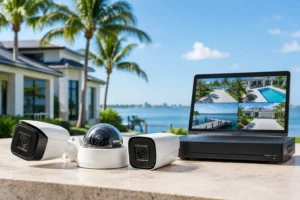
Outdoor cameras need protection from more than rain. Heat, humidity, salt air near the coast, storms, insects, direct sunlight, and fast-changing weather can all affect equipment and image quality. Outdoor-rated cameras are essential, but placement is equally important.
A camera mounted under an eave may receive better protection from rain and sun than one exposed on an open wall. It may also be easier to keep the lens clean. At the same time, it must be positioned low enough to capture useful facial detail and high enough to discourage tampering. There is no universal mounting height because the right position depends on the target area, lens choice, and nearby obstructions.
Landscaping should also be part of the review. Palm fronds, shrubs, and tree branches can trigger motion alerts or block a view as they grow. A camera plan should leave room for routine maintenance and anticipate how the property changes throughout the year.
A Security System Should Look Intentional
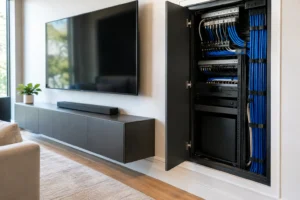
Security should add confidence, not visual clutter. Visible wires, awkward mounts, exposed power supplies, and cameras placed as an afterthought can undermine the appearance of a home or business. This is particularly true around front entries, patios, pool decks, restaurants, retail spaces, and professionally designed landscapes.
A polished installation considers the camera finish, mounting surface, cable routing, equipment location, and how the system fits with Wi-Fi, exterior lighting, access control, and smart home features. A camera covering a driveway can also be part of a broader plan that includes a video doorbell, gate access, landscape lighting, and reliable outdoor Wi-Fi.
That broader view prevents a common mistake: installing cameras first, then discovering that the network is too weak for stable viewing or that the recorder has no discreet place to live. Planning the system as part of the property produces a cleaner and more dependable result.
When Professional Design Makes the Difference
Do-it-yourself cameras can be useful for simple needs, but there is a point where professional design becomes the more practical option. Multiple buildings, large lots, weak Wi-Fi zones, commercial operations, outdoor entertainment spaces, and requirements for concealed wiring all call for a more complete approach.
An experienced installer can assess sightlines, recommend the right camera mix, verify network capacity, determine storage requirements, and install the equipment with clean finishes. Frequencies USA designs security camera systems around how each property is used, whether the priority is watching a front entrance, protecting a business, checking in on a vacation home, or keeping an eye on a pool area.
The right camera system should feel easy to use after installation. If checking a live view, finding a recording, or receiving a useful alert takes too much effort, the technology is not serving its purpose. Start with the moments you want to capture, then build coverage around them. That approach delivers security you can actually see and rely on.
 Previous Post
 Next Post