OLED QLED Comparison for Your Florida Home
A great TV can make a game day gathering, family movie night, or quiet evening at home feel completely different. But an OLED QLED comparison is not as simple as deciding which screen has the better specifications. The right choice depends on where the TV will live, how much daylight reaches the room, what you watch, and how you want the finished space to look.
For a dark media room, the answer may be very different than it is for a bright Tampa-area living room with wide windows, pool-door glare, and overhead lighting. Both OLED and QLED televisions can deliver an impressive 4K experience. The key is matching the display technology to the room and integrating it cleanly with sound, sources, controls, and concealed wiring.
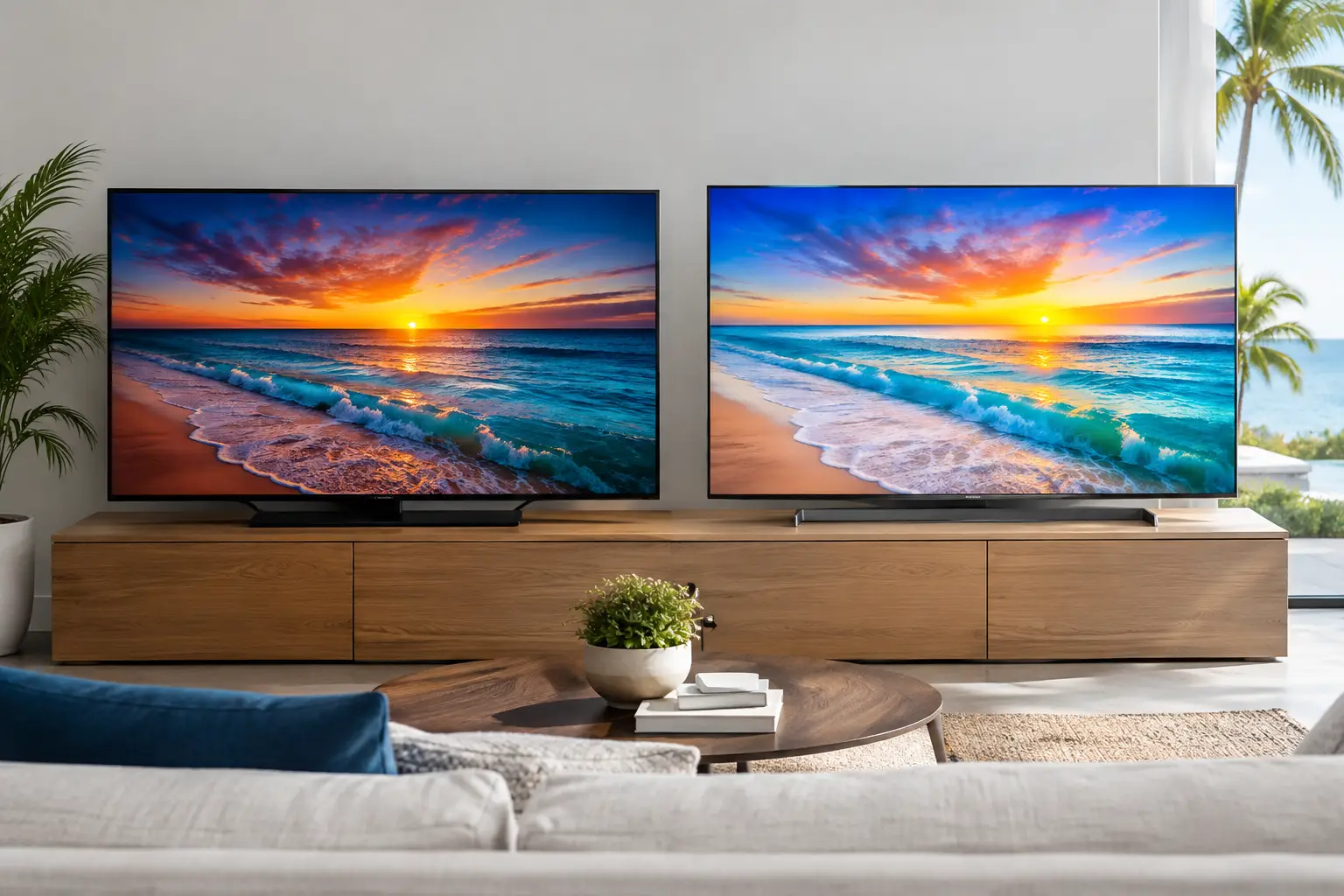
OLED QLED Comparison: The Core Difference
OLED stands for organic light-emitting diode. In an OLED TV, every pixel creates its own light and can turn off completely when the picture calls for black. That pixel-level control produces deep blacks, excellent contrast, and highly precise detail in dark scenes.
QLED is a variation of LED/LCD technology that uses a quantum-dot layer to improve color and brightness. The screen is still lit from behind, rather than having each pixel illuminate itself. Premium QLED models use advanced backlighting and local dimming to control bright and dark areas more effectively than standard LED TVs.
Neither technology is automatically right for every home. OLED generally wins where cinematic contrast and wide viewing angles matter most. QLED often has the advantage in bright, sun-filled rooms where high peak brightness helps the image stay vivid. The best choice is usually less about a label and more about the room’s lighting conditions and your viewing habits.
Picture Quality in a Dedicated Media Room
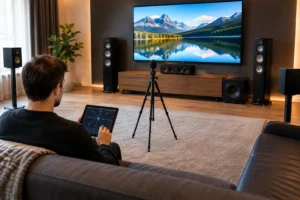
If your goal is a theater-style experience, OLED has a compelling advantage. When a scene fades to black, an OLED panel can shut off individual pixels rather than trying to block light from a backlight. Shadow detail appears more natural, letterbox bars look truly black, and bright objects in a dark scene have greater visual impact.
This matters with movies, prestige television, and high-quality streaming content. An OLED also handles off-center viewing especially well. In a media room where family and guests are seated across a wide sectional, people at the edges can still see consistent color and contrast.
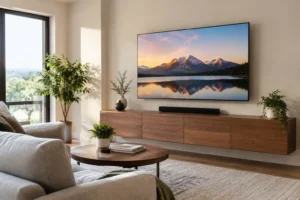
OLED sets are also exceptionally thin. That makes them an attractive option for a refined wall-mounted installation, particularly when paired with a low-profile mount and wiring hidden inside the wall. The screen becomes part of the room rather than a collection of visible cables, power strips, and components.
There are trade-offs. OLEDs do not typically reach the same sustained brightness levels as the strongest QLED models, and reflective rooms can reduce the benefit of those perfect blacks. They are at their best when lighting is controlled with shades, thoughtful fixture placement, or a room designed around viewing.
Why QLED Can Be Better for Bright Florida Rooms
A television placed opposite large windows faces a practical challenge: ambient light. Sunlight and indoor reflections can wash out darker scenes, regardless of how expensive the screen may be. This is where a high-quality QLED often makes a strong case.
QLED televisions are known for high brightness and vibrant color volume. In a bright family room, open-concept kitchen, office, sports bar, or covered outdoor entertainment area, that added brightness can help the picture hold up during the day. Sports broadcasts, news, casual streaming, and daytime gaming tend to look punchy and easy to follow.
Many QLED models are available in very large sizes at price points that can be more approachable than similarly sized OLED displays. That can make QLED appealing for homeowners who want a 75-inch, 85-inch, or larger screen without taking the full budget away from audio, control, networking, or installation.
Premium QLED sets with full-array local dimming can still produce excellent contrast. They may show some blooming, or a slight glow around bright objects against dark backgrounds, that OLED avoids. Yet in a room with considerable light, that difference may be difficult to notice while the extra brightness is immediately useful.
Gaming, Sports, and Everyday Viewing
For gaming, both OLED and QLED can be excellent choices when selected with the right features. Look for 4K resolution, a 120Hz refresh rate, variable refresh rate support, and low input lag. These features help motion appear smoother and controls feel more responsive on compatible consoles and gaming PCs.
OLED’s fast pixel response creates exceptionally clear motion, which can be attractive for fast-paced games and sports. Its contrast also gives games with dark environments, night scenes, and cinematic visuals extra depth. For a dedicated gaming room that is used mostly after dark, OLED is difficult to overlook.
QLED remains a smart choice for multipurpose spaces. If the same TV is used for Saturday football, cartoons in the afternoon, video calls, and gaming at night, its brightness is a real advantage. Some viewers also prefer QLED for channels with static logos, scoreboards, or news tickers that stay on-screen for hours each day.
That last point relates to image retention. Modern OLED TVs include protective features that reduce the risk of permanent burn-in, and most normal mixed use is not a concern. Still, if a screen will regularly display the same fixed graphics for long periods, a QLED may provide extra peace of mind. This is particularly relevant for commercial displays, sports-focused rooms, or households that leave a news channel on throughout the day.
Screen Size and Placement Matter as Much as Panel Type
A beautiful OLED or QLED TV can disappoint if it is too small for the seating distance, mounted too high, or placed where glare dominates the screen. Before choosing a model, start with the room. Measure the main seating position, identify windows and lighting sources, and consider where speakers, equipment, and power will go.
For most 4K TVs, viewers can sit closer than they could with older HD screens without seeing individual pixels. A larger display often creates a more immersive result, especially in a media room. However, bigger is not always better if the wall is narrow, the TV overwhelms the furniture layout, or the room is used for close-up casual viewing.
Mount height deserves the same attention. The center of the screen should generally sit near seated eye level in a living room or theater space. Mounting a TV above a fireplace can be visually convenient, but it can also place the screen too high and expose it to heat. A careful site evaluation can determine whether that location is practical or whether another wall will provide a more comfortable viewing experience.
Build the System Around the TV
The screen is only one part of the experience. A thin TV with built-in speakers cannot deliver the impact of clear, properly placed audio. Even a compact soundbar and subwoofer can make dialogue easier to hear and add energy to movies and sports. A dedicated surround sound system or theater audio design takes the experience further without filling the room with visible gear.
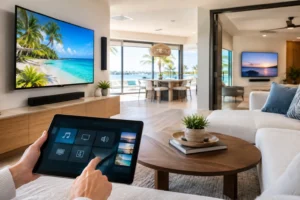
Professional integration also solves the issues that tend to frustrate homeowners after the TV is purchased: cables hanging below the screen, unreliable Wi-Fi streaming, too many remotes, and components that have nowhere clean to live. A properly designed installation can conceal wiring, place equipment in a cabinet or rack, improve wireless coverage, and provide simple control for the TV, audio, streaming devices, and lighting.
For outdoor areas, the conversation changes again. An outdoor-rated display is built to handle heat, humidity, and changing light better than an indoor TV. Brightness, placement, weather protection, and glare management should guide that decision more than OLED versus QLED alone.
Which Display Is Right for You?
Choose OLED when your priority is movie-night contrast, deep blacks, wide seating angles, and a premium theater look in a controlled-light room. It is especially well suited to dedicated media rooms, bedrooms, and sophisticated living spaces where the TV is primarily watched in the evening.
Choose QLED when the room is bright, the TV is used heavily during the day, or you want a very large screen with excellent color and brightness for sports and everyday entertainment. It is often the practical fit for open-concept homes, sunny family rooms, and commercial spaces.
At Frequencies USA, we help homeowners plan the full viewing environment instead of choosing a screen in isolation. A well-matched display, clean installation, dependable network, and easy control system turn a TV upgrade into a space your family actually enjoys using. Start with the room you have, the experiences you want to create, and the details you do not want to see once the project is finished.
 Previous Post
 Next Post