How Much Does Home Theater Wiring Cost?
A home theater can look clean and effortless on the surface, but the wiring behind it is where the real work happens. If you’re asking how much does home theater wiring cost, the honest answer is that most projects land somewhere between a few hundred dollars for a simple room and several thousand for a fully concealed, professionally integrated setup.
That range is wide for a reason. Wiring costs depend on the room, the number of speakers, whether the walls are open or finished, how far cables need to run, and how polished you want the final result to look. A basic living room upgrade costs far less than a dedicated media room with in-wall speakers, a projector, smart control, and equipment tucked neatly out of sight.
How much does home theater wiring cost for most homes?
For a straightforward soundbar and TV setup, wiring costs may stay in the lower end of the range, especially if outlets are already in the right place and there is minimal wall fishing involved. Once you move into surround sound, hidden cabling, equipment racks, and pre-wiring for future upgrades, pricing goes up quickly.
In many homes, professional home theater wiring falls into a few common tiers. A basic installation with one display and a few visible or lightly concealed connections may cost roughly $300 to $800. A mid-range setup with a mounted TV, receiver, and 5.1 or 7.1 speaker wiring often falls between $800 and $2,500. A more advanced custom theater with projector wiring, in-wall or in-ceiling speakers, subwoofer lines, control wiring, and a clean equipment location can easily run from $2,500 to $6,000 or more.
Those numbers usually reflect labor plus wiring materials, but not always the electronics themselves. Speakers, receivers, projectors, displays, remotes, and networking gear are often priced separately.
What drives the price up or down?
The biggest factor is access. If a room is under construction or being remodeled, running low-voltage cable is much easier and less expensive. Installers can route speaker wire, HDMI, network cable, and control lines before drywall goes up, which saves time and keeps labor lower.
Finished rooms are more complicated. Fishing wire through existing walls and ceilings takes more planning, more labor, and sometimes some minor cutting and patching. If the goal is a truly hidden install with no exposed cable raceways, that extra labor is often worth it, but it does affect the price.
Room size also matters. A compact media room with equipment near the display will cost less to wire than a large open-concept living area where rear speakers, subwoofers, or projectors are far from the main equipment location. Longer cable runs mean more material and more labor.
Then there is system complexity. A simple 3.1 setup needs fewer runs than a Dolby Atmos system with ceiling speakers. A wall-mounted TV with one source device is much simpler than a system with a receiver, game consoles, streaming devices, whole-home audio integration, and a universal remote. The more pieces that need to work together, the more time goes into planning, wiring, labeling, and testing.
Typical wiring components that affect cost
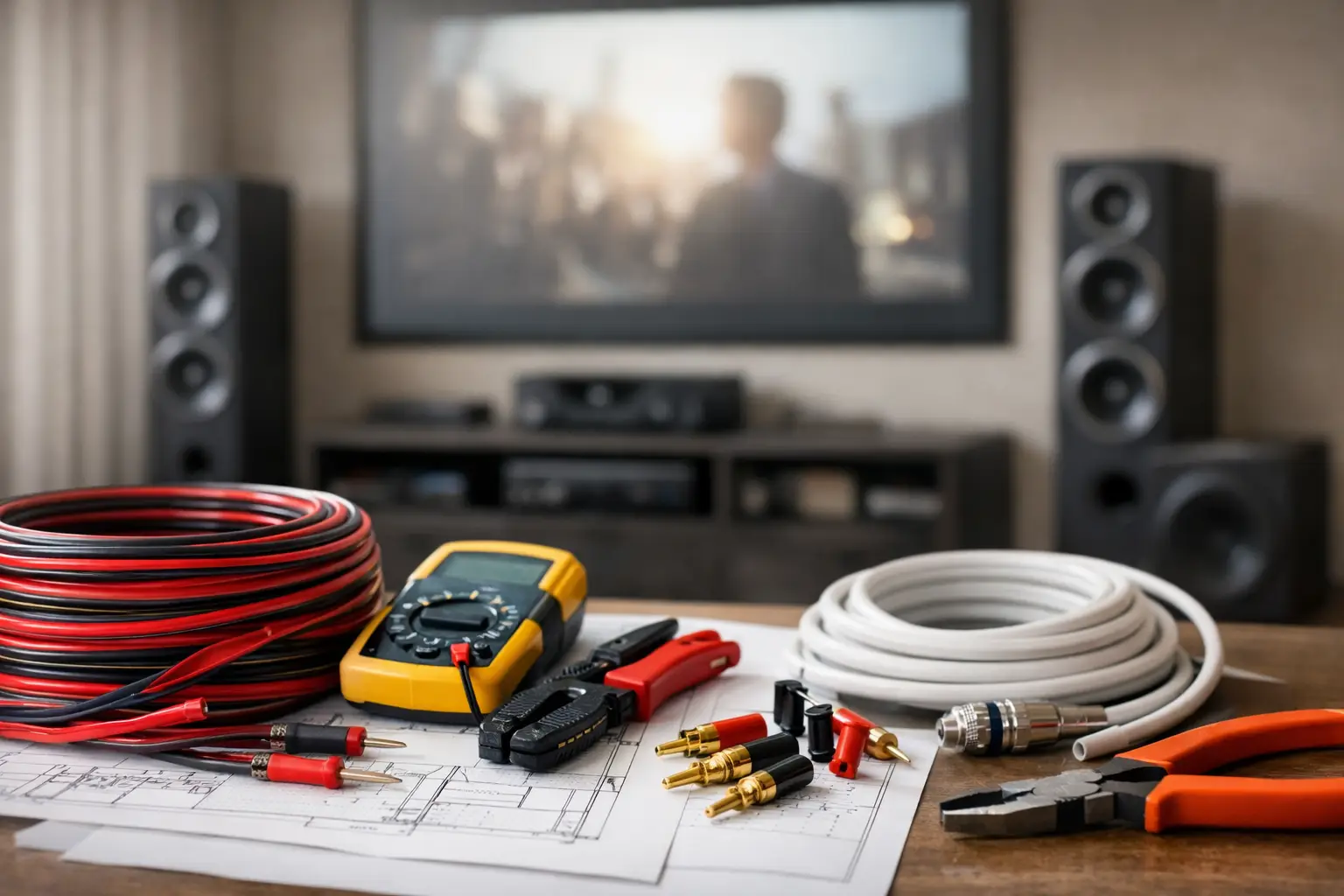
Home theater wiring is not just speaker wire. A polished system often involves several cable types working together behind the scenes.
Speaker wire is the obvious one, and the amount needed depends on the number and placement of speakers. Subwoofer cable may be required if the sub is not sitting near the receiver. HDMI cabling is another major piece, especially if equipment is stored in a cabinet or separate closet. For projector systems, longer HDMI runs or signal extension solutions can add cost fast.
Network cabling is often overlooked, but it matters. Many modern AV systems perform better with [hardwired internet connections] for streaming devices, smart TVs, control systems, and receivers. If your theater space also needs stronger [Wi-Fi or mesh networking support], that may be part of the scope.
Power work can also change the budget. Low-voltage installers typically handle signal wiring, but if the room needs new outlets, dedicated circuits, or power relocation behind a mounted TV or projector, a licensed electrician may also be needed.
New construction vs. retrofit pricing
If you are building a new home or finishing out a room, pre-wiring is one of the smartest upgrades you can make. It costs less to run cable before finishes are in place, and it gives you flexibility later. Even if you are not installing every speaker or component right away, pre-wiring for surround sound, projector use, and network connectivity helps future-proof the room.
Retrofit work in an existing home usually costs more because the installation team has to work around insulation, framing, fire blocks, and existing finishes. Some homes offer easy attic or crawlspace access, which helps. Others are much tighter and more labor-intensive. That is why two rooms that look similar on paper can have very different installation quotes.
DIY wiring vs. professional installation
Some homeowners consider handling the wiring themselves to save money. In a very simple setup, that can make sense. If cables are staying visible in furniture, or if the room is open during a renovation and you are comfortable with low-voltage runs, DIY may reduce upfront cost.
But there is a trade-off. Professional wiring is about more than getting signal from one device to another. It is about choosing the right cable paths, minimizing visible clutter, planning for ventilation and equipment access, avoiding signal issues, and making sure the finished space looks intentional. A good installation also accounts for everyday use so the system is easy for the whole family to enjoy.
When a system is wired poorly, the room may end up with exposed cords, unreliable connections, awkward speaker placement, or expensive rework later. That is where professional installation earns its value.
Hidden costs homeowners should plan for
One of the biggest surprises in home theater projects is that wiring cost is rarely just wire. Wall plates, back boxes, conduit, mounting hardware, cable management accessories, signal baluns or extenders, and equipment shelving can all be part of the job.
Patching and paint touch-up may also come into play if finished walls need to be opened for access. In some homes, installer time increases because of block construction, high ceilings, stone fireplaces, or limited attic access. Those are not unusual in Florida homes, and they can change the labor picture.
There is also the question of future readiness. Adding an extra HDMI line, spare speaker runs, or network cable during the initial install may cost a little more now, but it can save major labor later if you upgrade the room.
How to budget wisely for home theater wiring
The best budgets start with the experience you want, not just the gear list. Think about whether you want a casual family room setup, a true surround-sound media room, or a more immersive theater with projector and architectural speakers. Wiring should support the way the room will actually be used.
It also helps to decide early how important aesthetics are. If visible wires do not bother you, your budget can stay lower. If you want flush-mounted speakers, hidden components, wall-mounted displays, and clean sightlines, expect to invest more in labor and planning.
A professional estimate is the best way to get a realistic number because every room is different. An experienced installer will look at access points, construction type, equipment location, speaker layout, and control needs before recommending a solution. That keeps you from underbudgeting and helps you avoid paying for things you do not need.
When higher wiring costs are worth it
Not every room needs a premium buildout. But if you care about clean aesthetics, reliable performance, and simple day-to-day use, better wiring work usually pays off. The room looks better, the system works better, and upgrades are easier down the road.
For homeowners investing in entertainment spaces, poolside viewing areas, family rooms, or dedicated media rooms, the wiring is what makes the whole experience feel polished. It is the difference between a collection of devices and a space that actually feels designed.
That is why many Tampa-area homeowners choose a custom installation partner instead of piecing it together one cable at a time. A company like Frequencies USA can design around your room, your goals, and your budget so the finished result looks sharp, sounds right, and stays easy to use.
If you are pricing a project now, the smart move is to treat wiring as part of the system, not an afterthought. Done well, it disappears into the room and lets the entertainment take center stage.
 Previous Post
 Next Post