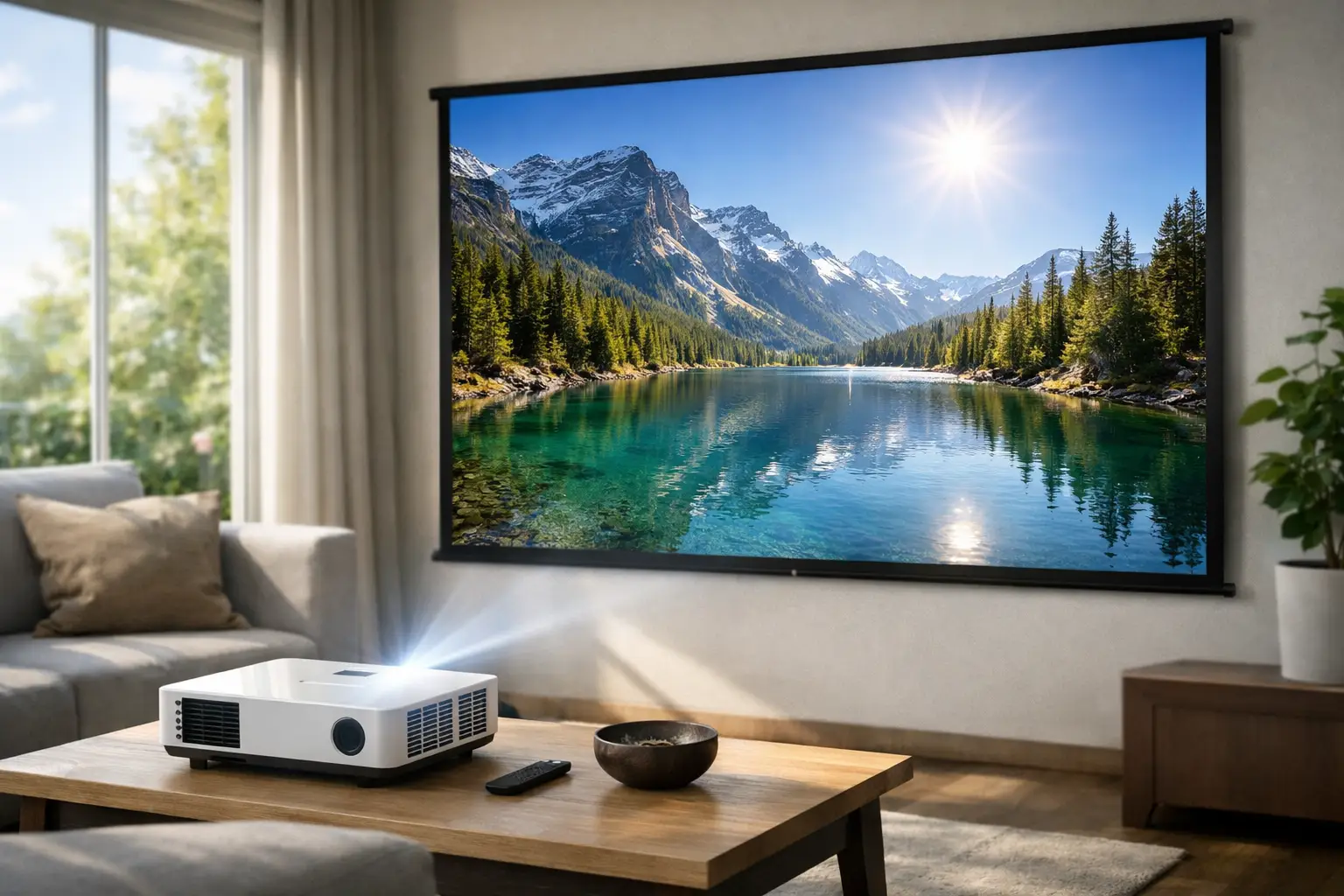
Best Projector Screens for Daylight Viewing
A projector can deliver a spectacular large-format image, but bright windows, overhead lights, and Florida sunshine change the equation fast. The best projector screens for daylight do more than provide a smooth surface – they help preserve contrast, direct more light toward viewers, and keep the room looking polished rather than washed out.
For a media room with open windows, a family room that gets afternoon sun, or a covered outdoor living area, the right screen is as important as the projector itself. The goal is not simply to buy the darkest or highest-gain material available. It is to match the screen, projector, room lighting, viewing angles, and installation style so the finished system is easy to enjoy every day.
What Makes a Projector Screen Work in Daylight?
A standard matte-white screen reflects light in many directions. That is ideal in a fully darkened theater, where it provides a wide viewing angle and natural-looking color. In a bright room, however, it also reflects light from windows, lamps, and light-colored walls back to the audience. Blacks turn gray, colors lose depth, and the image can feel flat.
Ambient-light-rejecting, or ALR, screens are built differently. Their layered or optical surface is designed to favor light arriving from the projector while reducing light that comes from other directions. A good ALR material can make a daytime image look noticeably richer, especially when the projector is ceiling-mounted and most unwanted light enters from the sides or above.
That does not mean every dark screen is an ALR screen, or that every ALR screen fits every projector. Some materials are designed for standard-throw or long-throw projectors. Others are specifically made for ultra-short-throw projectors, which cast light upward from a unit placed directly below the screen. Choosing the wrong category can create uneven brightness, sparkle, or a weaker image than a conventional white surface.
The Best Projector Screens for Daylight by Room
The right choice depends on how you use the space. A screen that looks excellent in a dedicated theater with controlled lighting may be unnecessary in a living room, while an outdoor screen needs an entirely different plan.
Premium Media Rooms With Windows: Stewart FireHawk G5
For homeowners who want a refined theater image without turning their media room into a black box, Stewart Filmscreen’s FireHawk G5 is a standout option. This is a premium angular-reflective material intended to improve perceived contrast in rooms with moderate ambient light while maintaining a composed, cinematic look.
It works especially well in finished media rooms where shades, lighting control, and thoughtful projector placement are part of the design. The trade-off is cost. Stewart screens are built for high-end custom installations, and the performance is best realized when the screen is paired with a properly specified projector and a room plan that limits direct light on the screen.
Bright Family Rooms: Screen Innovations Slate 1.2
Screen Innovations Slate 1.2 is a practical choice for multipurpose living spaces. Its ALR surface is designed to help reject ambient light while retaining a bright, punchy image for sports, gaming, streaming, and everyday television replacement.
This kind of screen suits a family room with recessed lighting, windows off to the side, and a ceiling-mounted projector. It will not defeat direct sunlight pouring across the screen, but it can make a meaningful difference when the room is bright rather than sun-blasted. For many homeowners, that is the difference between a projector used only at night and one used throughout the day.
High-Contrast Luxury Installations: Screen Innovations Black Diamond
Screen Innovations Black Diamond is one of the better-known premium ALR options for spaces where visual impact matters. Its darker surface helps maintain contrast in brighter rooms, which can be particularly appealing for customers who want a theater-sized image without compromising the clean, open feeling of a main living area.
A darker ALR material can produce impressive black levels, but it needs careful setup. Projector brightness, lens position, seating layout, and room reflections all matter. Some high-contrast materials have narrower optimal viewing zones than matte white screens, so a professional design is valuable when the room has wide sectional seating or multiple viewing areas.
Ultra-Short-Throw Setups: Elite Screens Aeon CLR 3
An ultra-short-throw projector can be an attractive alternative when ceiling mounting is impractical or when a room needs a simpler, furniture-based layout. For these projectors, a ceiling-light-rejecting, or CLR, screen such as the Elite Screens Aeon CLR 3 is the appropriate category.
CLR materials are engineered to reflect the light rising from an ultra-short-throw projector toward the audience while rejecting light coming down from ceiling fixtures. They can be highly effective in bright rooms, but alignment must be exact. Even a minor placement error can affect image geometry and uniformity. This is not a screen type to mount casually and adjust later.
Covered Patios and Outdoor Areas: Weather-Appropriate Projection Surfaces
Outdoor projection during the day requires realistic expectations. No projector screen can overcome direct Florida sun. If sunlight is hitting the screen, the image will be weak regardless of screen price or projector brightness.
For covered patios, pool areas, and outdoor kitchens, the best approach is to control the environment first. Position the screen in full shade, choose a location that faces away from the brightest part of the sky, and use exterior shades, curtains, or architectural features to block side light. A fixed outdoor-rated screen or a protected retractable screen can then support better daytime and early-evening viewing.
If daytime sports viewing is the main goal, a weather-rated outdoor TV may be the more reliable solution. A projector becomes the better choice when you want a very large image for movies, events, and nighttime entertaining. In many outdoor spaces, combining both gives the homeowner the most flexibility.
Screen Features That Matter More Than Marketing
When comparing daylight screen options, start with material type rather than a generic “4K” or “HD” label. Most quality modern screens can display high-resolution content. The material’s light behavior is what determines whether the image remains satisfying in your room.
Gain is also worth understanding. A gain rating describes how much light a screen reflects back toward the viewer compared with a standard matte-white surface. Higher gain can make the picture appear brighter, but it may reduce viewing angles or create a brighter center area, often called hot spotting. Lower-gain materials can look more uniform but may require a brighter projector.
Screen color matters as well. Gray and black ALR surfaces can improve perceived contrast in rooms with ambient light, but they also absorb some of the projector’s output. That is why projector brightness cannot be chosen separately from the screen. A screen that looks extraordinary with a properly matched projector can seem dim with an underpowered one.
Finally, consider the frame and installation. A fixed-frame screen provides the flattest surface and strongest theater look. It is usually the best performance choice for a dedicated wall. Motorized screens are ideal when the screen needs to disappear after use, such as in a living room or multipurpose commercial space. Tensioned motorized models are worth considering because they help prevent waves and edge curl over time.
Room Design Still Comes First
Even the most capable ALR screen has limits. Direct light on the screen is the enemy, so window treatments, dimmable lighting, darker wall finishes near the display wall, and controlled lighting zones often improve the image as much as a screen upgrade.
Projector placement should be planned early, especially in rooms with high ceilings, ceiling fans, decorative beams, or large windows. Clean cable routing, a correctly positioned outlet, and a mount that allows precise alignment make the installation feel intentional. They also avoid the visible wires and improvised adjustments that can take away from an otherwise beautiful space.
For a polished result, the screen, projector, audio system, lighting, and control method should work as one system. A single remote or keypad scene that lowers the screen, turns on the projector, adjusts lighting, and starts the audio makes a large-screen experience feel effortless instead of technical.
Choose for the Way You Actually Watch
The best daylight screen is rarely the one with the boldest specification sheet. It is the screen that fits your room’s light, your projector type, your seating layout, and the times of day you plan to watch. A premium ALR screen can be a smart investment for a bright living room, while a well-shaded patio and an outdoor-rated display may offer a better answer for midday viewing.
If you are planning a projector system in Tampa Bay, Frequencies USA can help design the screen, projector, audio, lighting, and concealed wiring around your space. A professional assessment can turn a bright, challenging room into an entertainment area that looks as clean when it is off as it does impressive when the picture comes on.
 Previous Post
 Next Post