Commercial Displays Versus Consumer TVs
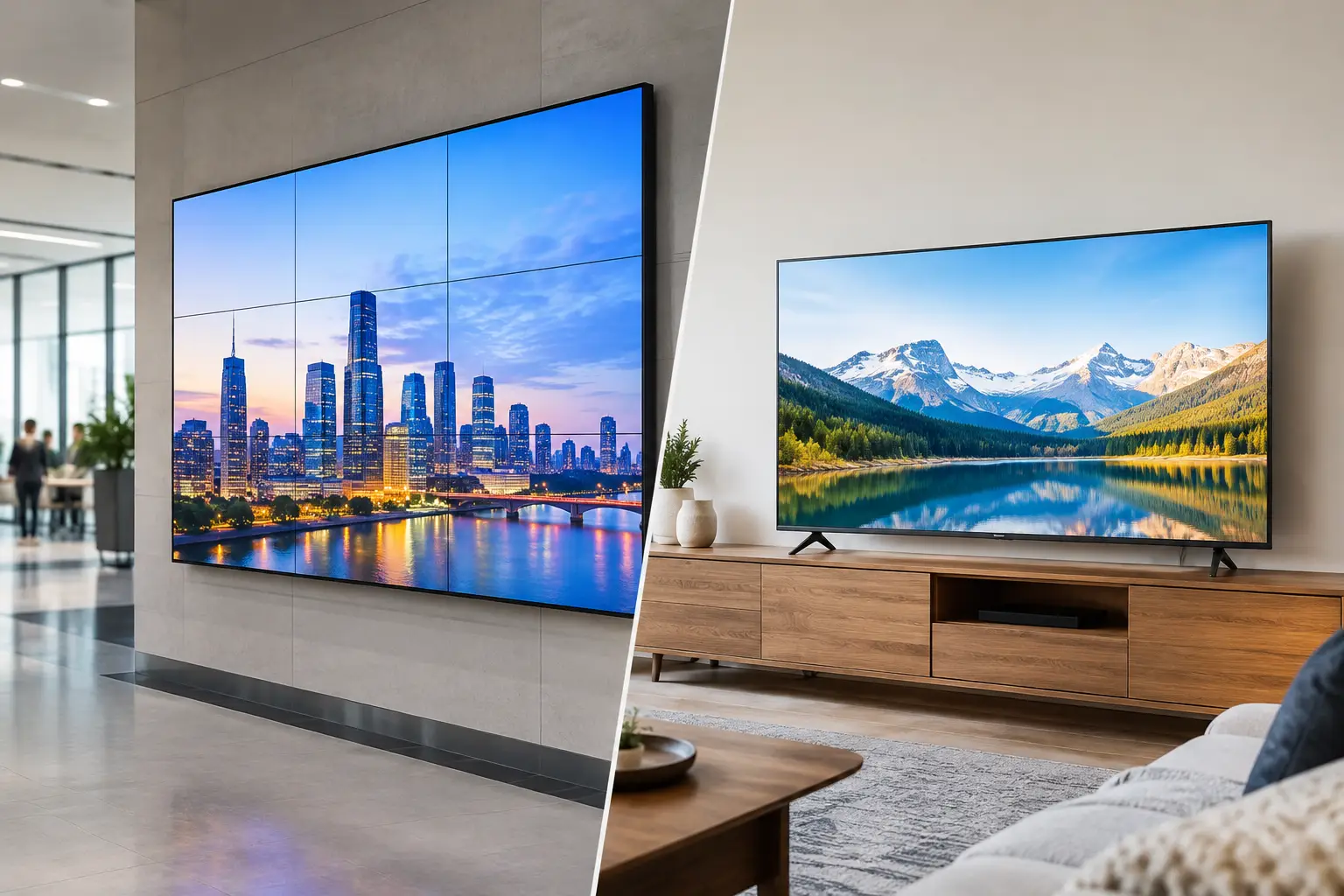
A television that looks perfect in a living room can become the weak point of a business AV system. That is the practical difference behind commercial displays versus consumer TVs. Both may show a menu, presentation, promotions, security camera feeds, or game day coverage. But their internal components, warranties, controls, and intended workloads are built for very different environments.
For a conference room that is used a few hours each week, a quality consumer TV may be a sensible value. For a restaurant menu board, medical waiting room, retail display, fitness studio, or lobby screen running all day, a commercial display is usually the more dependable investment. The right choice depends less on the screen’s size and more on how, where, and how long it will be used.
The Core Difference: Designed Use
Consumer TVs are made for home entertainment. Manufacturers expect them to run for a limited number of hours each day, sit in landscape orientation, and be adjusted occasionally with a handheld remote. Their priorities are picture quality, smart-TV features, and a price point that appeals to homeowners.
Commercial displays are made for business duty. They are designed to handle long operating hours, repeat the same content reliably, integrate with professional control systems, and maintain a polished appearance in public-facing spaces. Many are rated for 16/7 or 24/7 use, meaning they can operate 16 hours a day or continuously without being pushed beyond their intended role.
That rating matters. A screen that is left on from opening to closing every day accumulates use quickly. A consumer television might still work in that environment, but it is more likely to experience premature wear, image retention, overheating, or warranty limitations. Buying the less expensive screen can become costly if replacement requires new mounting, rewiring, programming, and business downtime.
Commercial Displays Versus Consumer TVs: Where They Differ
Operating hours and durability
The most meaningful distinction is duty cycle. Commercial displays use components and thermal management intended for sustained operation. They often have better ventilation, heavier-duty power supplies, and panels selected for repeated daily use.
This does not mean every business needs a 24/7-rated display. A small office that turns on a screen for occasional meetings may not benefit enough to justify the added cost. But a display that supports customer messaging, daily operations, or continuous entertainment should be selected like business equipment, not like a weekend purchase.
Brightness in real business environments
Brightness is another major factor, especially in Florida spaces with abundant natural light. A consumer TV can look impressive in a dim showroom but appear washed out near windows, entryways, patios, or bright overhead lighting.
Commercial displays are commonly available with higher brightness levels and anti-glare finishes that help content remain readable throughout the day. This is particularly valuable for menus, scheduling displays, promotional signage, and information screens where viewers need to read text quickly. A vivid image is nice. A screen that customers can actually read is better.
For outdoor or partially exposed locations, the conversation changes again. Standard indoor TVs and standard commercial displays are not built for heat, moisture, rain, direct sun, or insects. An outdoor-rated display and properly planned installation are the appropriate solution for pool areas, restaurant patios, clubhouses, and covered entertainment spaces.
Portrait mounting and image retention
Many businesses need vertical screens for directory boards, digital posters, social content, or menus. Most consumer TVs are intended to remain horizontal. Mounting one in portrait orientation can restrict heat dissipation and may void the manufacturer warranty.
Commercial displays are often engineered for landscape or portrait installation. They also tend to offer stronger protection against image retention, which can happen when a static logo, ticker, menu layout, or security camera interface stays visible for long periods. No display is completely immune to this issue, especially with fixed content, but commercial models provide settings and panel designs better suited to managed, repeatable content.
Control, scheduling, and installation flexibility
A business screen should not require someone to find the remote every morning. Commercial displays can offer remote monitoring, scheduled power on and off, input management, serial or network control, and compatibility with centralized AV systems. That makes daily operation easier for staff and more consistent for customers.
For example, a restaurant can schedule its displays to turn on before service, switch from menu content to sports programming at the appropriate time, and power down automatically after closing. A conference room can start with a presentation-ready screen instead of a streaming app home page. These details remove friction and keep technology from becoming another task for employees.
Commercial units also typically include more installation-oriented inputs and settings. Depending on the model, that may mean professional-grade connectivity, video-wall support, USB content playback, daisy chaining, locking controls, or concealed cable routing options. A clean installation is not only more attractive. It protects equipment and makes maintenance easier.
Warranty coverage and service expectations
Warranty language is easy to overlook until there is a problem. Consumer TV warranties commonly limit commercial use or exclude it entirely. If a television is used as a menu board and fails early, the business may have little recourse even if the product is still within its advertised warranty period.
Commercial displays generally include warranties that specifically support business use. Terms vary by manufacturer and model, so the details should always be confirmed before purchase. Still, commercial coverage reflects a basic reality: the screen is expected to perform as part of a working environment.
When a Consumer TV Is the Right Choice
A consumer TV is not automatically the wrong choice for a business. It can be an excellent fit when usage is light, the room is controlled, and the screen does not carry operational responsibility.
Consider a quality consumer TV for a small break room, a private office, an occasional training space, or a residential-style lounge where the screen is used for entertainment rather than continuous messaging. It can also make sense for a homeowner’s media room, man cave, bedroom, or indoor living area, where cinematic image quality and smart features may matter more than commercial scheduling tools.
The key is honest planning. If the screen will run only a few hours a day and can be easily accessed or replaced, the cost savings may be worthwhile. If it is mounted high above a bar, built into millwork, or required to display information all day, the initial savings can disappear quickly.
Match the Display to the Full AV System
The display itself is only one part of the experience. Screen placement, viewing distance, ambient light, source equipment, audio, network reliability, mounting method, and cable concealment all affect the final result. A premium commercial screen can still feel disappointing if it is too small for the room, positioned in glare, paired with weak Wi-Fi, or connected with visible cables.
For businesses, a thoughtful system design also considers who will operate it. Staff should be able to switch sources, adjust approved settings, and recover from common issues without calling an IT professional. For homeowners, control should feel equally simple: one remote, one app, or a clean wall control instead of a collection of confusing remotes.
At Frequencies USA, the goal is not simply to hang a screen. It is to create a finished space where the display, sound, control, and wiring work together and look intentional.
A Smarter Way to Make the Decision
Before choosing a display, consider its daily operating hours, whether it needs to be vertical, the amount of daylight in the room, how visible the content must be, and whether staff need scheduled or centralized control. Also consider the cost of failure. If a screen goes dark, is it a minor inconvenience or does it interrupt sales, communication, or the guest experience?
A consumer TV can deliver excellent value in the right setting. A commercial display earns its higher price when reliability, brightness, warranty support, and professional control truly matter. The best screen is the one that fits the space, the workload, and the people who need to use it every day.
 Previous Post
 Next Post