Surround Sound Calibration for a Better Home Theater
A home theater can have premium speakers, a large display, and plenty of power yet still sound disappointing. Dialogue gets buried, bass booms in one seat and disappears in another, and effects that should move naturally around the room seem stuck near the front wall. Surround sound calibration is what turns a collection of great components into one convincing entertainment experience built around your room.
For homeowners, that difference is felt immediately. You stop reaching for the remote every time someone speaks quietly, action scenes gain impact without becoming harsh, and music sounds balanced rather than overly bass-heavy. Calibration is not a luxury finishing touch. It is the work that allows a theater, media room, or living room system to perform the way it was designed to perform.
What Surround Sound Calibration Actually Fixes
Calibration is the process of measuring, adjusting, and fine-tuning a surround system so every speaker works together at your main seating area. It accounts for speaker location, distance, volume level, crossover settings, subwoofer output, room acoustics, and the processing inside the AV receiver or surround processor.
The room matters as much as the equipment. A dedicated theater with carpet, acoustic treatments, and a centered seating row behaves very differently from an open-concept Florida living room with tile floors, glass doors, high ceilings, and a kitchen nearby. Neither room is a lost cause, but each needs a different approach. A system should be tuned to the space people actually use, not to an ideal room on a product box.
Proper setup also corrects the small timing errors that make a surround field feel disconnected. If a rear speaker is only a few feet from the couch while the front speakers are across the room, they cannot all play at the same level and timing. The receiver needs accurate distance and level information so a sound effect can travel from front to back smoothly, rather than jumping from speaker to speaker.
Clear dialogue starts with the center channel
The center speaker carries most movie and TV dialogue. When it is placed too low, blocked by cabinetry, aimed at knees instead of ears, or set below the proper level, voices lose clarity. Raising the center level can help, but it is not always the right answer. Too much gain can make dialogue sound detached from the actors on screen.
A better result comes from positioning and aiming the speaker correctly, then matching it to the left and right channels. In rooms where the center must sit below a wall-mounted TV, a slight upward tilt can make a meaningful difference. Calibration confirms the adjustment with measurement and real listening, not guesswork.
Bass should feel powerful, not unpredictable
Subwoofers are often blamed for bad bass, when the real issue is the room. Low frequencies build up in corners, cancel each other at certain seats, and react strongly to walls, furniture, and room dimensions. That is why a subwoofer can sound huge near one wall and thin from the main couch.
A quality calibration includes thoughtful subwoofer placement, phase adjustment, level setting, and crossover configuration. In many rooms, two properly placed subwoofers produce more even bass across multiple seats than one larger subwoofer. That does not mean every home needs two subs. A smaller media room with one primary seat may perform beautifully with a single well-placed unit. The best option depends on the room, seating layout, and how much low-frequency impact you want for movies, games, and music.
A Professional Surround Sound Calibration Process
A polished result begins before anyone opens a calibration menu. Speaker placement and clean installation come first. Front speakers should create an appropriate soundstage around the display, while surround and height speakers need locations that support the intended format. Concealed wiring and flush, well-planned speaker placement keep the room looking refined without sacrificing performance.
Once the physical system is in place, the calibration process typically follows a practical sequence.
First, each speaker is checked for correct wiring and polarity. A speaker wired out of phase may still make sound, but it can weaken bass and blur the front soundstage. Next, distances from the listening position are measured or verified so the processor can apply the right delay to every channel.
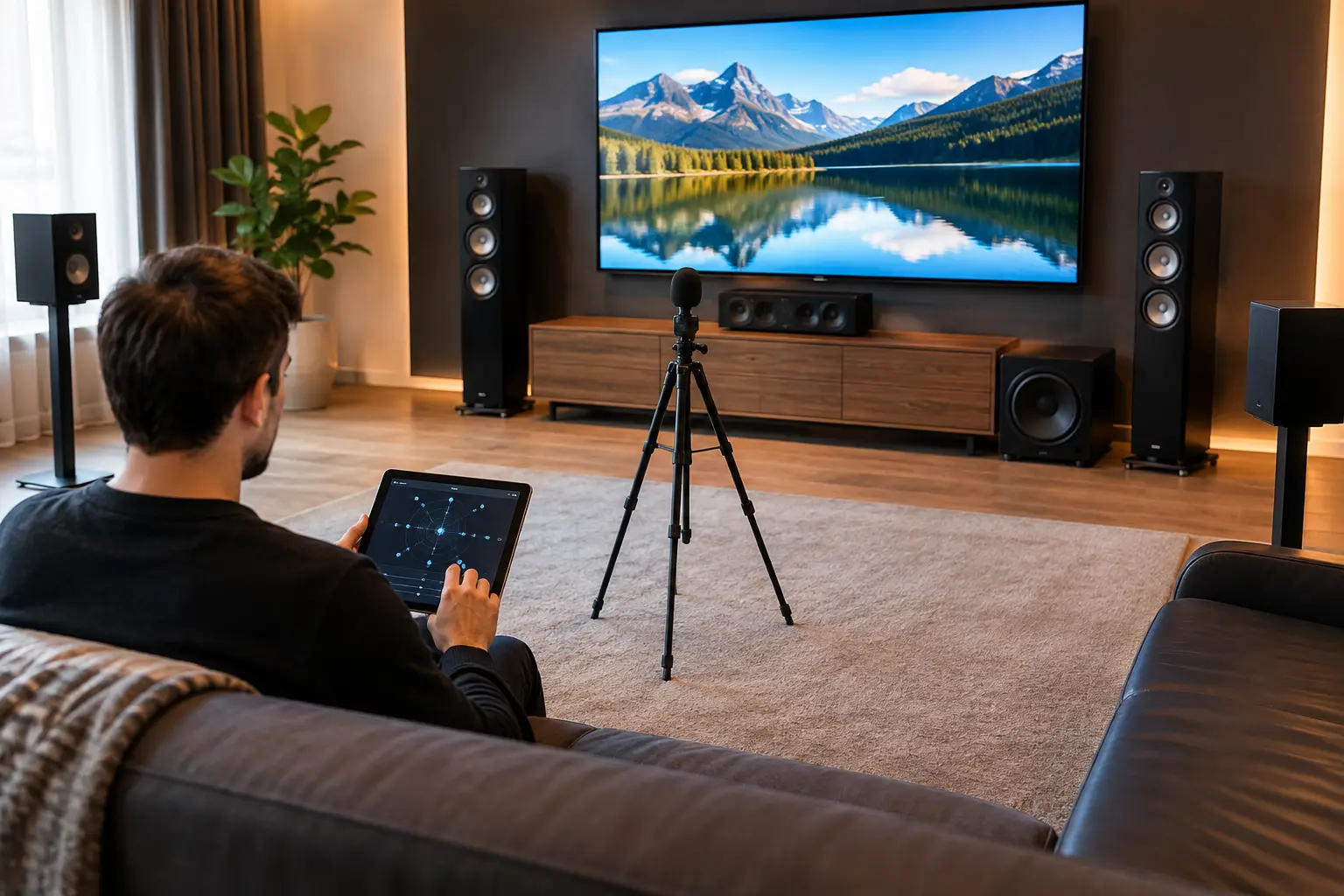
Then, speaker levels are balanced using a calibrated microphone and test tones. The goal is not to make every speaker equally loud at the cabinet. The goal is to make each channel arrive at the listener at the appropriate level. This gives surround effects a realistic sense of movement and keeps the front stage anchored to the screen.
After that, crossover settings are selected. A crossover determines when lower frequencies are handed from a speaker to the subwoofer. Small in-wall, bookshelf, and satellite speakers generally benefit from handing off more bass than large floor-standing speakers. Still, larger speakers are not automatically better when run full range. Letting a capable subwoofer handle demanding low frequencies can give the entire system more headroom and control.
Finally, room correction software is measured and reviewed. Many modern receivers include platforms such as Audyssey, Dirac Live, ARC Genesis, or proprietary systems from the manufacturer. These tools can be very effective, but they are not a substitute for correct placement. They work best when the system is physically designed well first.
Why automatic room correction is only part of the job
Running the receiver’s included microphone once from the center of the couch is better than doing nothing. It is also easy to get incomplete results. The microphone must be placed carefully at ear height, multiple measurements need to represent the listening area properly, and the software’s final recommendations should be reviewed instead of accepted blindly.
For example, automatic software may set a speaker to “large” because it detects deep bass output. In a real-world system, changing that speaker to “small” and applying a sensible crossover may provide cleaner performance. It may also recommend a subwoofer level that measures accurately but feels too restrained for a movie-focused room. The right adjustment depends on the client’s preferences and the program material, not a one-size-fits-all target curve.
Calibration Should Match How You Use the Room
A theater used primarily for blockbuster movies deserves a different final voicing than a living room used for sports, streaming, family movie nights, and background music. Movie lovers may prefer a more immersive surround presentation and deeper subwoofer impact. Music listeners may care more about a focused front soundstage and natural tonal balance. Families often benefit most from reliable dialogue clarity at comfortable listening levels.
Listening modes matter as well. A properly calibrated system should make it simple to enjoy content without sorting through confusing options. The system can be configured so movies use the appropriate surround format automatically, while stereo music remains natural and direct. Easy control is part of a successful installation. Advanced technology should enhance a Friday night at home, not create another remote-control problem.
When a Professional Makes the Biggest Difference
Professional calibration is especially valuable when the room has challenging acoustics, multiple subwoofers, in-ceiling speakers, Dolby Atmos channels, or a mix of existing and new equipment. It is also worthwhile after a renovation, furniture change, new receiver installation, or speaker upgrade. Even moving the main couch a few feet can change how bass behaves at the primary listening position.
For homes in the Tampa Bay area, hard surfaces and open floor plans are common challenges. Tile, large windows, and wide transitions between rooms can make sound feel bright or uneven. A professional can recommend practical improvements without turning a living room into a recording studio. Sometimes that means adjusting placement and processing. Other times, an area rug, curtains, upholstered furniture, or discreet acoustic treatment is the more effective solution.
Frequencies USA approaches the process as part of the complete system design. That includes equipment selection when needed, clean concealed wiring, speaker placement that respects the room’s aesthetics, and final tuning that makes the system easy to enjoy. The goal is not to fill a room with visible gear. It is to create an immersive space that looks intentional and sounds exceptional.
Keep Your System Sounding Its Best
Once a system is calibrated, avoid changing receiver settings casually. Raising individual speaker channels or changing crossover settings can undo the balance that was established. If dialogue seems harder to hear later, first check whether a streaming app, cable box, or television has changed its audio output format.
It is also smart to revisit calibration after major changes. A new sectional, a relocated subwoofer, different speaker positions, or a new TV console can affect sound more than expected. A quick professional check can restore the impact and clarity you enjoyed on day one.
The best home theater should disappear into the experience: clear voices, believable movement, full bass, and a room that still looks like your home. When every channel is tuned for the space and the people in it, pressing play becomes the only step that matters.
 Previous Post