10 Family Room Home Theater Ideas That Work
A great family room theater should not feel like a theater that took over the house. The best family room home theater ideas make Friday movie nights feel bigger, while still leaving the room comfortable for cartoons, game days, guests, and quiet evenings at home. The difference is thoughtful planning: equipment that fits the room, sound that stays clear at normal conversation levels, and wiring that disappears from view.
For Florida homeowners, there is another practical layer. Bright daylight, open-concept floor plans, tile floors, and frequent entertaining can all affect the design. A professionally planned system accounts for those details before the first screen goes on the wall.
Start With How Your Family Actually Uses the Room
Before choosing a television or speaker package, consider what happens in the space on an average week. Is the family room primarily for streaming movies? Does it become the gathering place for football and UFC events? Are kids playing games there while someone else cooks in the nearby kitchen? A room built around one use can be frustrating when life calls for another.
A flexible setup usually begins with a large, high-quality TV rather than a projector. Modern 4K and 8K televisions deliver excellent brightness in rooms with windows and overhead lighting, making them a strong fit for most family rooms. A projector can still be the right answer in a darker dedicated media space or a room with motorized shades, but it asks more of the environment. Daylight and ambient light can quickly reduce its impact.
Screen placement matters just as much as screen size. Mounting a TV too high over a fireplace may preserve a wall layout, but it can strain viewers’ necks and compromise the viewing angle. If the fireplace is the only logical location, a specialized pull-down mount can bring the screen closer to eye level when it is in use. It is a small adjustment that makes a noticeable difference during a two-hour movie.
Family Room Home Theater Ideas That Keep the Room Beautiful
The highest-performing equipment does not need to dominate the decor. In a family space, visual polish is part of the experience. Concealed wiring, properly positioned outlets, recessed equipment storage, and custom-painted speaker grilles keep the focus on the room, not the components.
Choose speakers for the room, not the showroom
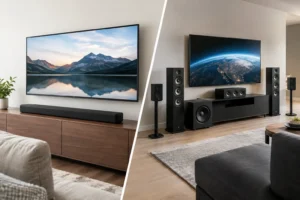
A soundbar is an easy improvement over TV speakers, especially for a smaller room or a simple streaming setup. However, it has limits. Dialogue can still struggle in a large open room, and the soundstage will remain concentrated at the front of the space.
For a more cinematic result, consider a 5.1 surround system with left, center, right, and surround speakers plus a subwoofer. The center speaker does much of the work for dialogue, which is why a real center channel can make movies easier to follow without constantly raising the volume. In-wall and in-ceiling speakers offer a clean look, while carefully selected bookshelf or floor-standing speakers may be a better choice for homeowners who want a more traditional high-performance audio system.
There is a trade-off with in-ceiling speakers. They are nearly invisible and excellent for background music, but a full theater system benefits from surround speakers placed closer to ear level when possible. The right answer depends on the furniture layout, ceiling height, and how discreet the system needs to be.
Give the subwoofer a proper place
Bass is what makes action scenes, concerts, and big game broadcasts feel physical rather than flat. It is also the component most likely to create complaints if it is simply tucked into a corner without planning. A properly calibrated subwoofer adds depth without turning every explosion into a rattle throughout the home.
Room construction, seating position, and open doorways all change how bass behaves. Sometimes one subwoofer is enough. In a larger open-plan family room, two smaller subs can produce more even bass across several seats than one oversized unit. Calibration is where the system starts sounding intentional instead of merely loud.
Build lighting into the entertainment experience
Harsh ceiling lights can wash out a screen, while a completely dark room is not always practical for a family gathering. Layered lighting creates a better balance. Dimmable recessed lights, wall sconces, accent lighting, and low-level lighting behind the TV can improve comfort without distracting from the picture.
Smart lighting control makes this even easier. A single “Movie” setting can lower the room lights, close compatible shades, turn on the system, and set the correct source. For game day, another setting can keep the room brighter for food, conversation, and guests. The technology should reduce steps, not create a new set of instructions for everyone in the house.
Plan Seating and Acoustics Before Finalizing Equipment
The sofa is not just furniture in a home theater plan. It defines the primary listening position and influences where speakers, the display, and even the subwoofer should go. If possible, center the main seating on the TV wall and avoid pushing every seat against the back wall. Leaving some space behind the sofa often improves surround sound and bass response.
Hard Florida-style interiors can look beautiful, but large tile floors, glass doors, and bare walls can make sound feel bright or echoey. You do not need to cover the room in acoustic panels to make it comfortable. An area rug, upholstered seating, curtains or motorized shades, and soft decor can absorb enough reflection to improve dialogue and reduce fatigue during long viewing sessions.
Open-concept homes require realistic expectations. Sound will travel into the kitchen, hallway, and adjacent living areas. Instead of chasing extreme volume, focus on clarity. Good speaker placement and calibration let everyone hear dialogue and details at a more reasonable level.
Keep Sources, Controls, and Wi-Fi Simple
A family room system can include streaming apps, cable or satellite, game consoles, a Blu-ray player, whole-home audio, and more. Without a plan, that can mean several remotes, confusing inputs, and a cabinet full of blinking boxes. A professionally integrated control system puts the common functions in one easy interface, whether that is a handheld remote, wall keypad, or app.
The goal is straightforward: press one button and the right equipment turns on, the TV selects the right input, the sound switches to the theater speakers, and the lighting adjusts. Guests should be able to watch something without a tutorial. Kids should not be able to accidentally change a setting that requires a service call to fix.
Reliable Wi-Fi is equally important. Streaming in 4K, online gaming, smart TVs, and connected controls all depend on a strong network. If the family room has weak coverage or frequent buffering, a high-end display will not solve the underlying problem. A properly designed mesh Wi-Fi network or hardwired connection can make the entire entertainment system feel faster and more dependable.
Leave Room for Future Upgrades
Technology changes, but the infrastructure behind it can serve the home for years. Running conduit, installing quality in-wall wiring, and allowing access to equipment make future upgrades far easier. A homeowner may start with a soundbar and later add surround speakers. Another family may want a larger screen after rearranging the room. Planning ahead protects the investment and avoids opening finished walls later.
Equipment should also have ventilation. Receivers, game consoles, cable boxes, and networking gear produce heat, particularly when stored in a closed cabinet. Proper airflow prevents performance issues and helps extend the life of the components.
Make the System Feel Effortless
The most successful family room theater is not defined by how many components it has. It is defined by how naturally it fits into everyday life. A bright, properly mounted display, clear dialogue, controlled bass, clean wiring, and one-touch operation can transform a familiar room without making it feel overly technical.
Frequencies USA designs family room systems around the way each household lives, from a refined TV-and-soundbar upgrade to a fully concealed surround sound installation with smart lighting and dependable Wi-Fi. A free estimate is a practical first step toward a room that looks polished, works simply, and gives every movie night a reason to feel special.
 Previous Post
 Next Post