Man Cave Entertainment System Setup That Works
A great man cave should not make you hunt for a remote, fight Wi-Fi dropouts during a big game, or stare at a tangle of cords behind the TV. The right man cave entertainment system setup turns a spare room, garage conversion, bonus room, or dedicated media space into the place everyone wants to gather – with cinematic picture, room-filling sound, dependable connectivity, and controls that simply make sense.
The goal is not to fill the room with the most gear. It is to design the system around how you actually spend time there. A football-focused viewing room has different priorities than a golf simulator lounge, a gaming retreat, or a home theater built for movie nights. A professionally planned system brings those priorities together while keeping the finished space clean, comfortable, and easy to use.
Start With How the Room Will Be Used
Before choosing a television, projector, speakers, or furniture, decide what the room needs to do most often. This choice affects nearly every installation decision, from screen placement to lighting control.
If sports are the main event, you may want a large primary display with one or two additional screens for multiple games. For movies, a projector and projection screen may create the more immersive experience, especially in a room with controlled lighting. Gamers typically benefit from low-latency displays, direct wired network connections, and equipment placement that keeps consoles accessible without leaving cables on display.
Many Florida homeowners also want their man cave to work as a casual entertaining space. In that case, consider whether the audio should stay contained in the room, extend to a nearby patio, or play throughout other zones of the home. Planning for this from the beginning avoids having to reopen walls later when you decide the sound should reach the pool area or outdoor kitchen.
Room conditions matter, too. A window-heavy room may favor a high-brightness TV over a projector. A garage conversion may require more attention to cooling, insulation, and Wi-Fi coverage. A smaller room may sound better with a carefully designed surround system than with oversized speakers placed wherever they happen to fit.
Choose the Right Display for the Experience
The display is often the visual centerpiece, but bigger is not automatically better. Screen size should match the seating distance, room layout, and type of content you watch. A massive screen can feel impressive for sports and movies, yet it can become tiring if viewers sit too close or if the room cannot support the size comfortably.
For most multi-purpose man caves, a premium large-format TV offers excellent brightness, sharp detail, and reliable performance for sports, streaming, and gaming. It is usually the better choice in spaces with ambient light, especially when windows, doors, or overhead lighting cannot be fully controlled.
A projector can be the right answer for a dedicated theater-style environment. It delivers the scale many homeowners want for movies and big events, but it asks more of the room. You need thoughtful screen placement, controlled lighting, proper projector mounting, and a clean way to conceal power and signal cables. A projector is not simply a large TV substitute. When designed correctly, it creates a different kind of experience.
For rooms that need more than one screen, avoid treating every wall as available real estate. Multiple displays should feel intentional, with comfortable viewing angles and a layout that does not overwhelm the room. A main screen combined with smaller secondary displays is often more usable than several equally sized TVs competing for attention.
Build Sound That Matches the Screen
Thin TV speakers are fine for background viewing. They do not deliver the impact of a stadium crowd, a movie soundtrack, or a competitive gaming session. Audio is where a well-designed room stops feeling like a TV room and starts feeling like an entertainment space.
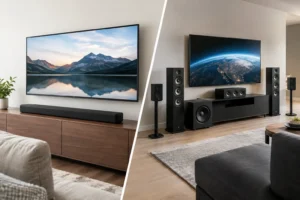
A soundbar can be a clean, practical option for a compact man cave or a simpler upgrade. For a more immersive room, a dedicated surround-sound system creates separation between dialogue, effects, music, and low-frequency impact. Properly positioned speakers make a real difference. A dramatic subwoofer placed in the wrong location can overwhelm the room, while correctly balanced speakers can provide powerful sound without making every conversation difficult.
In-wall and in-ceiling speakers are especially useful when clean aesthetics are a priority. They reduce visual clutter and preserve floor space, while professionally installed speaker grilles can blend into the room rather than distract from it. The trade-off is that speaker locations need to be planned early, particularly if walls or ceilings will be finished, painted, or covered with acoustic treatments.
Audio should also match the way the room is shared. If the man cave sits beside bedrooms, a nursery, or a home office, the system may need thoughtful volume management and room tuning. More bass is not always the best solution. The best system is one you can enjoy at an exciting level without creating problems elsewhere in the house.
Do Not Let Wi-Fi Be the Weak Link
Streaming, online gaming, live sports, smart TVs, voice control, and connected receivers all depend on the network. A beautiful display and premium sound system will still feel disappointing if the stream buffers during a playoff game or a console loses connection in the middle of a match.
Whenever possible, key entertainment devices should use hardwired network connections. A wired connection gives streaming devices, gaming consoles, AV receivers, and smart TVs a more consistent path to the internet than Wi-Fi alone. That does not mean wireless coverage is unimportant. Phones, tablets, guests, smart remotes, and other connected devices still need strong, stable coverage throughout the space.
A properly designed Wi-Fi mesh network can solve common dead-zone issues, particularly in detached garages, additions, large homes, and rooms separated by concrete block or exterior walls. The best approach depends on the property. Sometimes an access point or wired backhaul is the better answer; sometimes existing network equipment simply needs to be upgraded and placed more strategically.
Plan the Man Cave Entertainment System Setup Around Control
The fastest way to make an entertainment system frustrating is to give it five remotes, several apps, and a complicated startup sequence. If turning on the TV requires switching inputs, powering up an audio receiver, opening a streaming app, and finding the right remote, the room will never feel as relaxing as it should.
A smart control system brings the experience together. With a single remote, touchscreen, wall keypad, or mobile app, you can turn on the room, select a source, adjust the volume, lower the lights, and start a movie or game. The best controls are not flashy for the sake of it. They remove the small annoyances that keep people from using the system to its full potential.
Scene-based control is particularly useful in a man cave. One button can set up Game Time by powering on the displays, selecting the preferred sports source, setting the audio level, and adjusting lighting. Another can create Movie Night with dimmed lights, the projector or main display active, and surround sound ready to go. These details make the space feel polished without making it complicated.
Hide the Equipment, Not the Performance
Clean installation is a major part of the finished result. Wall-mounted TVs look better when power, HDMI, network, and speaker wiring are concealed. Equipment racks, recessed media boxes, and dedicated cabinetry can keep receivers, gaming consoles, cable boxes, and network components organized while still allowing access for service and ventilation.
Ventilation deserves special attention. AV equipment generates heat, and tightly closed cabinets can shorten component life or cause performance issues. A well-designed equipment location includes airflow, cable management, access, and enough capacity for future additions. It may be tempting to hide everything inside a small cabinet, but a thoughtful layout protects the investment and keeps operation reliable.
The same principle applies to power protection. Quality surge protection and power management help safeguard electronics from electrical events. In areas prone to storms and power fluctuations, this is a practical part of protecting a high-value entertainment system.
Add Lighting That Supports the Room
Lighting can make a man cave feel finished, especially when it is designed around viewing comfort. Bright overhead fixtures can wash out a screen and create reflections. Dimmable recessed lights, wall sconces, LED accent lighting, and lighting zones provide much more control.
For a sports lounge, brighter lighting around a bar, dartboard, or seating area can work well while the screen zone stays comfortable. For movies, low-level pathway and accent lighting can provide atmosphere without distracting from the picture. Smart lighting controls make these adjustments simple and can be included in the same control system as the AV equipment.
A polished man cave does not need to look like a commercial sports bar or a dark theater. It should reflect the homeowner’s style while supporting the entertainment experience.
Design It for the Next Upgrade, Too
Technology changes, and your habits may change with it. Leave room for additional sources, a future gaming console, expanded audio zones, another display, or upgraded networking. Planning extra conduit, accessible cable paths, and sufficient rack space is far less disruptive than retrofitting after the room is complete.
For homeowners in the Tampa Bay area, a custom installation can also account for the specific realities of Florida homes: block construction, open-concept layouts, outdoor entertaining, and the need for reliable connectivity across larger properties. The result should look intentional on day one and stay flexible when your needs grow.
Your man cave should be the room where the technology disappears into the experience. When the picture is right, the sound fills the space, the Wi-Fi holds steady, and one control handles the room, you are free to focus on the game, the movie, and the people you invited over. A free professional estimate can help turn that vision into a clean, dependable installation built around the way you entertain.
 Previous Post
 Next Post