How to Choose Outdoor Speakers for Florida Homes
A great outdoor audio system should let you hear every song by the pool without turning the volume into a neighborhood event. That is the real starting point for how to choose outdoor speakers: design for even, comfortable sound across the space, not one oversized speaker blasting from the house.
Florida backyards also place tougher demands on equipment than a covered indoor room. Heat, humidity, rain, lawn irrigation, salt air near the coast, and bright sunlight all influence which speakers will perform well and continue looking polished over time. The best system balances sound quality, durability, easy control, and a clean installation that fits the way you use your patio, pool deck, lanai, or outdoor kitchen.
Start With How You Use the Space
Before comparing speaker models, picture a normal Saturday at home. Are you playing relaxed background music while the family swims, watching football from an outdoor TV, or hosting larger gatherings around a kitchen and bar? Each use calls for a different level of coverage and control.
For casual listening on a small covered patio, two properly placed all-weather speakers may be enough. A larger pool area, long lanai, or outdoor kitchen often benefits from four or more speakers spread across the listening area. More speakers set at lower volume usually sound fuller and more comfortable than two speakers pushed hard.
Also consider where people will actually sit and move. Music should reach the dining table, lounge chairs, grilling area, and pool deck with similar clarity. If a space has distinct areas, such as a quiet patio and an active pool zone, separate audio zones give you more flexibility. You can keep music low near the house while raising it slightly around the pool, or turn one area off entirely.
Choose Outdoor Speakers by Coverage, Not Just Size
Speaker size matters, but it is not a shortcut to better sound. A larger 6.5-inch or 8-inch outdoor speaker can produce stronger bass and play louder than a compact 4-inch model. That can be useful in an open yard where sound has no walls to contain it. Still, the right number and placement of speakers matter more than choosing the largest cabinet available.
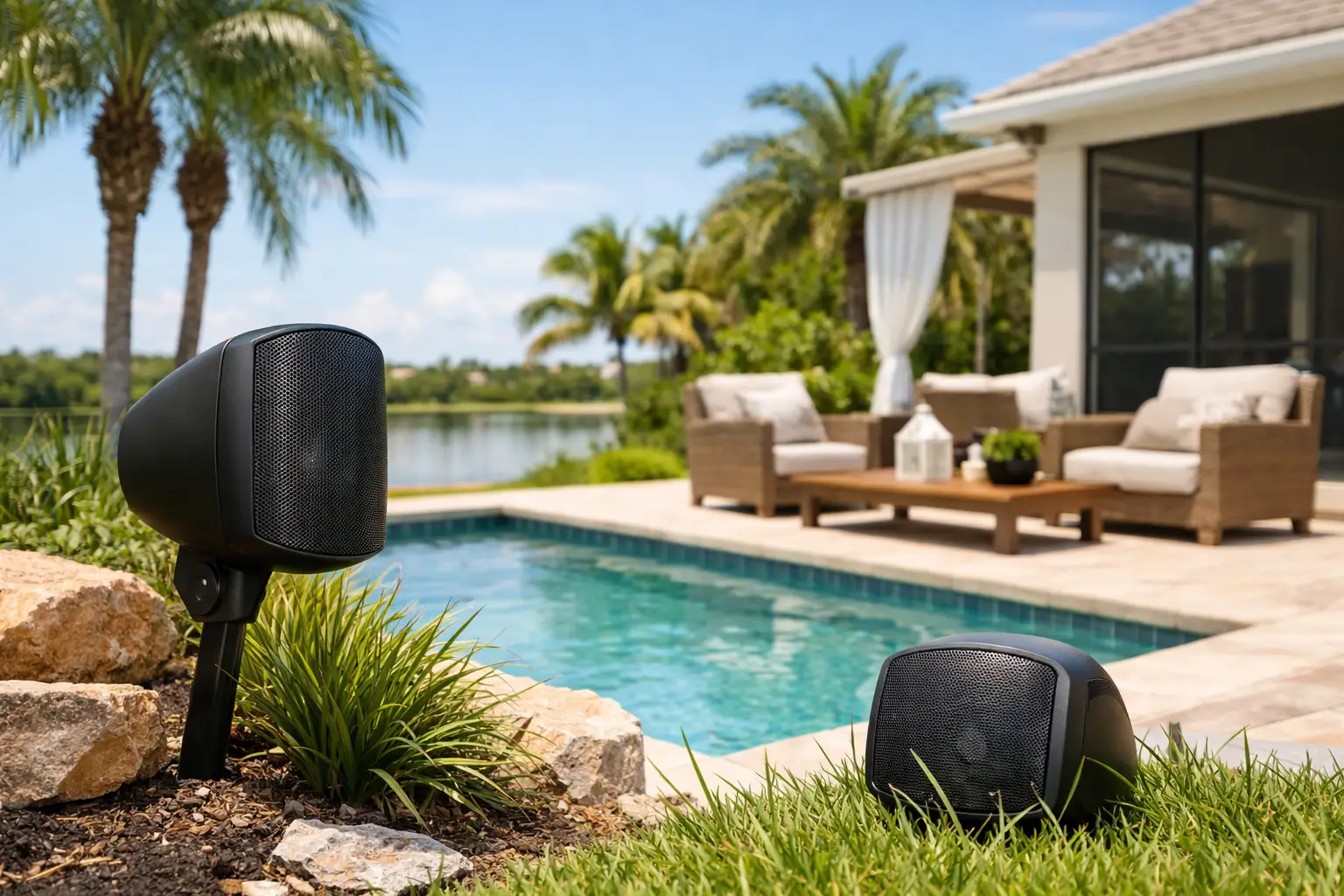
Wall-mounted speakers work well under eaves, on patio columns, and near an outdoor kitchen. They provide direct, focused sound and are a strong option for covered entertaining areas. Landscape speakers are installed throughout planting beds and point sound toward the home or seating areas. They are ideal for larger yards because they create a more natural sound field without placing bulky speakers on every wall.
For a refined landscape system, a buried outdoor subwoofer can add the low-end presence that small satellite speakers cannot create on their own. This is especially valuable for music lovers, but it also improves movie and sports audio around an outdoor television. The trade-off is a more involved design and installation, which is why it is worth planning speaker locations before landscaping is finished.
Look for Real Weather Protection
Outdoor-rated is not a vague marketing feature. The speaker enclosure, grille, mounting hardware, wiring connections, and finish all need to withstand the conditions around your home. Look for products specifically built for exterior use, with UV-resistant materials, corrosion-resistant hardware, sealed enclosures, and an appropriate weather-resistance rating.
A covered lanai offers some protection, but it is still exposed to humidity, wind-driven rain, and temperature changes. Speakers near a pool must also tolerate splashes and chemical exposure. In Clearwater, St. Petersburg, Madeira Beach, and other coastal areas, salt air adds another layer of corrosion risk. Choosing indoor speakers for a protected porch may seem like a cost-saving move, but their appearance and performance often decline quickly.
Placement extends the life of any outdoor speaker. Mount wall speakers under an overhang when possible, avoid aiming them where sprinklers regularly hit, and use hardware made for the specific speaker. A clean professional installation should also hide and protect cable runs rather than leaving exposed wire to collect sun damage, moisture, or accidental cuts.
Match the Speakers to the Amplifier
Outdoor speakers need enough clean power to sound clear at the volume you want. An underpowered or poorly matched amplifier can distort when guests are outside talking, the pool equipment is running, or traffic noise picks up. Distortion is not just unpleasant. Over time, it can damage speakers.
Pay attention to speaker impedance, amplifier channel capacity, and the number of speakers planned for each zone. Connecting too many conventional speakers to a basic receiver can overload the equipment. For a larger landscape system or commercial patio, a 70-volt audio system may be the better choice. It allows multiple speakers to be distributed over longer wire runs and lets the installer fine-tune volume in different areas.
Specifications are useful, but they do not replace system design. The dimensions of the space, speaker sensitivity, mounting location, ambient noise, and desired listening level all affect the proper amplifier choice. A system should have enough headroom to stay clean, not merely enough power to make sound.
Plan Placement Before Running Wire
The most polished outdoor audio systems are planned around the space instead of added as an afterthought. In a wall-mounted setup, speakers should generally be placed high enough to avoid accidental contact, angled toward listeners, and spaced to cover the area evenly. Do not mount both speakers close together on one wall if the entertaining area stretches across the yard.
For landscape speakers, position the satellites around the perimeter and aim them inward. This keeps the music focused on your property and reduces spillover toward neighbors. It also makes volume feel more consistent as people walk from the patio to the pool or fire pit.
Keep speakers away from direct water exposure, but do not hide them so thoroughly that sound is blocked by dense plants, furniture, or architectural features. An experienced installer can coordinate speaker placement with lighting, irrigation, pool equipment, and landscaping so the finished system looks intentional. Concealed wiring is a major part of that result.
Make Control Easy for Everyone
The best outdoor system is one your family will actually use. If starting music requires several remotes, a complicated app sequence, or a trip inside to adjust the receiver, the system will feel less enjoyable than it should.
Choose controls based on your habits. A mobile app is convenient for streaming services and quick volume changes. A weather-protected wall keypad can be useful near an outdoor kitchen or pool door. Integrated smart-home control can combine outdoor audio with lighting, television, and other entertainment features from one familiar interface.
Think about sources, too. Bluetooth can be convenient for a simple setup, but it has range limitations and ties the system to one person’s phone. Wi-Fi streaming systems offer better range, multi-room audio options, and access to multiple music services. A stable outdoor Wi-Fi signal is essential if you plan to stream around the pool or use a smart TV outside.
Consider Your Neighbors and Local Environment
Outdoor sound travels farther than most homeowners expect, especially at night. A system with distributed speakers lets you enjoy clear music at moderate levels instead of forcing volume high enough to reach the far end of the patio. Speaker direction matters just as much. Aim sound toward your home and gathering areas, not toward the property line.
If you live near the water or in a dense neighborhood, this approach protects both your listening experience and your relationships with neighbors. It also keeps dialogue clearer for outdoor television, where loud volume alone rarely solves the problem.
When Professional Design Makes Sense
A simple pair of patio speakers can be a straightforward project. But once you add a pool area, multiple zones, landscape speakers, an outdoor TV, lighting, hidden wiring, or whole-home audio, the details quickly add up. Professional design helps prevent uneven coverage, exposed cable, mismatched components, weak Wi-Fi, and equipment placed where heat and moisture will shorten its life.
Frequencies USA designs outdoor entertainment systems around the property and the people using it, from discreet patio speakers to full landscape audio with simple control. The goal is not to fill the yard with gear. It is to create an outdoor space that sounds exceptional, looks clean, and is ready whenever you want to relax or entertain.
A thoughtful plan now makes it easier to expand later, whether that means adding a new seating area, outdoor television, landscape lighting, or a separate zone for the pool. Start with the experience you want outside, then choose equipment and placement that make that experience feel effortless.
 Previous Post
 Next Post